Thursday, 5 May 2016

The White City


Doorways.
A VW Beetle - quite common here.
I know I've talked about border crossings before as well as bus trips, but it is a quintessential part of travelling in South America. They go hand-in-hand, and sometimes you cross border multiple times in a day or night - like Europe of old before most of the border checks got taken down. Sometimes in Europe you still get checked, usually people shopping in Andorra and bringing back duty free cigarettes and booze, but if you have a van you get stopped all the time - borders and sometimes even as your driving into town with foreign plates. Spain is quite big for this - the police seem to always be on the lookout for people, and having a big white van was never an asset. One time I was driving into the town an Huesca in northern Spain, late at night, and the Policia Nacional pulling me over, shotgun leveled. Quick look in the van, and a question: "Senyor, what have you got in the back?" to which I always reply (at border checks or airports) "dirty laundry," which always stops them from caring. Anyway, I have gone slightly off track. No border checks this night, but I was on an overnight bus to the 2nd biggets city in Peru - Arequipa.


Snowy peaks.

Outdoor confessions.
The Cathedral of Arequipa.
Getting out of your bus at 7am is never pleasant after a bad night's sleep. Bus terminals are horrible in South America - always full of people, bad smells and people calling out for bus tickets or food, dogs roaming for scraps... interesting though, but not fun when you are alone with all your bags and you need the loo. Fishing around for that loose change without taking your backpacks off is great entertainment for the locals, but you don't want to leave your bags on the group unguarded, and end up taking them all in. Some baños here as well charge different prices - one for liquids and more for a 'number 2.' Not sure why, but I think it's the extra paper you need - the woman tried to charge me more because I has carrying a 20kg bag on my back... very cheeky. I wasn't impressed with Arequipa at first, and sitting in the taxi to my hostel wasn't doing my hopes any good. Normally I don't do taxis, but I checked and it was way too far to walk loaded down like a mule in this heat, and the taxi cost less than $3 - hard to argue with. I somehow managed to get a private room and ensuite for the same price as a dorm (mix up in my favour?) for 20 sole a night ($8), and a 5 minute walk to the centre. I chilled out on the rooftop terrace for a bit, trying to wake up after my journey, as was amazed that I could see Mount Misti peeking through the clouds. This is lucky, as the postcards and Google images will make you think you can see it everyday from the main plaza - I only saw it once.

Plaza de Armas.
Beautiful archways of the main Plaza.
Doorways in here always lead to good things!
It was founded in 1540 by the Spaniards (yes, them again!) and originally called "Villa Hermosa de Nuestra Señora de la Asuncion" or The Beautiful House of Our Lady Santa Maria. Mouthful! I don't know when they changed the name, but I'm glad they did - the modern name supposedly coming from the local language (Aymara) and means, "ARI" for "summit" and "QUIPA" for "laying behind" which would mean the volcano behind the city. The city was very important for it's economic prosperity as well as it's loyalty to the Spanish Crown, and is still a wonderful example of Spanish Colonial Architecture. Most of the buildings in the centre are built from white 'sillar,' a volcanic stone - churches, stairs, walkways and the city hall are all made of of this beautiful white stone, giving it the name "The White City." Straight streets run up and down the city in a grid pattern, and there are so many doorways leading into atrium and small courtyards that walking around the small historical centre can take days if explored properly. It was declared the capital of Peru in 1835 (and was until Lima took it's place in 1883) when the country gained it's independence, it became a UNESCO World Heritage site and today is full of tourists and locals shopping in it's streets, eating at it's great restaurants and also for trip to Colca Canyon.


SSSHHHHHH!!!
Red arches.
Blue arches.
One of the city's main sights is the Convent of Santa Catalina. Right in the heart of town, it was built in 1580 and designed as a 'city in a city.' High walls surround the goings-ons inside, and until it was opened to the public in 1940, nearly 400 years later, nobody knew what went on there. One of the biggest convents in the world, it houses 450 nuns at it's peak and was completely shut off from the world, keeping itself in mystery and silence - now it's the cities biggest attraction, and the price 40 soles ($16) doesn't stop them coming. I decided to visit either this or the museum where you can see "Juanita," a girl completely frozen during an Incan offering to the gods back in the mid-late 15th century. My budget was low and you can't see everything, so the Monastery it was, although I would have loved to have seen both. As you walk in, you immediately see the large painted letters spelling out "Silencio" and continue your walk in complete silence - it works! Then again, I did the walk alone, so I didn't really have much choice in the matter. Brightly coloured in red and blues, the buildings are beauitful - simple but beautiful. Arches walkways, wooden doors, small apartments for the nuns with communal kitchens and small single beds with crosses above them. There wasn't much information as usual, so my mind wandered and I started to picture what life would have been like here - the North part of the building is still a functioning nunnery, and you see nuns walking around the city too.


Whoah, that's DEEP!
The church on Plaza de Armas.
A kitchen in the Monastery.
Walking around the main Plaza de Armas, there are people calling out to you for tours and restaurants, most of which are for Colca Canyon (or Cerviche for food). I grabbed some info, and all these places offered tours with a guide. I decided to do it alone, and gob a mini-van from my hostel at 3am. They pick you up at this time and it's a 5 hour drive, and you want to reach a certain part by 9am - the place where the Condors come for breakfast. The Canyon is claimed to be the deepest in the world by the locals here, but the internet states differently, saying that it is the second deepest, but still twice that of The Grand Canyon in the USA. 160kms North West of Arequipa, it is 3,270m deep and receiving more than 120,000 visitors every year, it is Peru's 3rd biggest tourist destination. We stopped at the Cruz del Condrs (Condor's Cross) at around 8:30am and were told by the guide (the rest of the bus were doing the guided tour and I was just using the bus) that we had 30 minutes free time. I walked around, looked at the canyon, took some pictures and enjoyed the view, but wanted some condors. 8:55am, heading back to the van and out they came - nobody listened to the calls of the driver who was revving his engine and trying to get us back in. These huge beasts came circling around the heads of the people at the lookout, sometimes coming within metres of clipping people with their huge wings. Like clockwork these majestic birds turn up at the same time everyday as they get fed - something I don't have a problem with as the experience was awesome! After loads of pictures and shouts from the driver and guide, we piled back in and drove down the road 5 more kilometres for the start of the hike.


The area around Cola Canyon.
Cruz del Condor at 9am.
One of the many condors at Cruz del Condor.
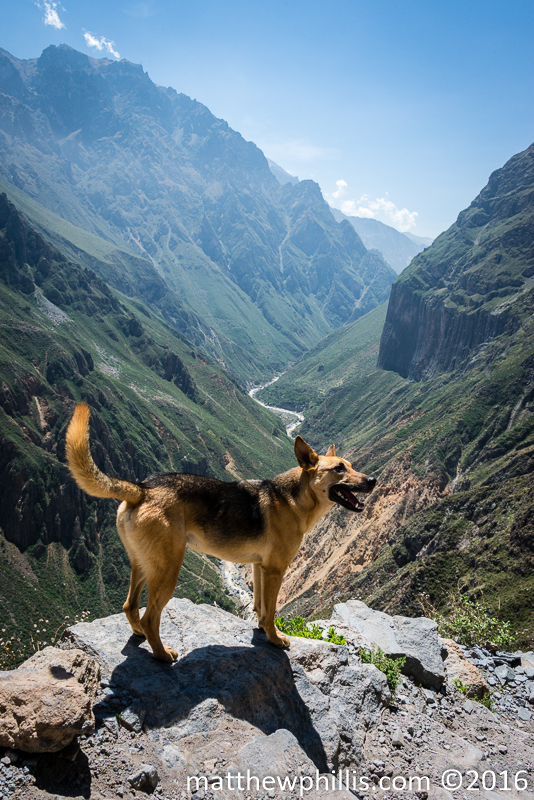
Most people do this hike over 3 days and with a guide - I planned (and I use that word losely) for a 2 day hike and no guide. I was here to hike alone, enjoy the peace and quiet of nature and walking, not to listen to people talk all the time. I ran a little ahead of the bus group and set off, but stopped every 5 minutes to just stop, look and appreciate. It was also very hot! I looked across the canyon and could see the river below, the mountains towering above everything else, and the path that zig-zagges up and down the sides, knowing that I would have to face that very soon! I was 'guided' down by a lovely golden dog of some sort, who was happy to just walk alongside me, receive a few pats, and drink my water and eat my pasta lunch left-overs. The hike down was pretty hard going, but the view was spectacular. I walked 18kms for the day, and made it down to the bottom, crossed a bridge and part way back up before heading down to my hotel for the night at "the Oasis." The oasis is a small 'island' in the middle of the river between the steep walls of the canyon, and I think the perfect place to stay. I met a dog before heading down and he was happy to follow and guide me down, and even sat and had a rest while I drank an Inca Cola (my favourite soft drink of Peru!). My new dig for the night was pretty basic - stone cabin with a stone bed, and the matress wasn't much softer, but it had a great pool. The dog followed me down to the pool and chilled for a bit before wandering off to guide some other tourists around. Dinner was simple, but cheap, and I shared the meal with some other travellers, all the while listening and watching the biggest pop star in Peru on TV. Her name is Luz Yenny de los Andes, and not to knock local culture and music, but her songs are all the same, in sound and sight. She's a little Peruvian woman who dances and sings her way round Peru, and she loves what she does if the video clips are anything to go by.


Scary bird eyes.
A hummingbird on a cactus.
(one) of my 4-legged tour guides.

I started off early after sleeping like the dead, and I knew it was going to be hard getting back up that damn canyon. It took me around 3.5 hours of zig-zag paths, all up hill to reach the top, and I ran out of water an hour from the top - I gave a dog the last of it. He was clearly very much in need of it, and I felt I needed to give something back to the local community, especially since he was my dog from the first day - how or why he was now on the other side of the canyon was beyond me. He accepted gratefully, gave me a lick on my hand, and continued off to do his job and guide the two people he was leading down. I thankfully reached the top and found a farmer's irrigation ditch and washed my head and face, but not drinking it as much as I wanted to. I just had enough time to buy some water at a local store (and have a funny conversation with the ladies there about me having no water), grab an 'almuerzo' and jump on the bus back to Arequipa. Thouroughly enjoying my time in Peru, and one of my favourite's here in South America. Who can go past a city like Cusco, the ruins of Machu Picchu and the White City with it's canyon close by? My next bus would be a long one - all the way to Lima, the capital of Peru.

Arequipa, thank you for the wonderful time

Monday, 25 April 2016

Return to Cusco

Leaving already?
It wasn't real, I checked...
The (tourist) town of Agua Calientes.
I'm not the sort of person who throws around the phrase 'bucket list' and things you have to do before you die, but I guess I just 'crossed off' one of those. Some people also talk about places and countries as 'done,' so when you ask them "where have you been in Asia?" they would reply "I've done Vietnam, Thailand... and oh yeah, we DID Cambodia last year." What is 'doing' a country supposed to mean? It annoys me, and so do people that always say "it was amaaaaaazing!" about everything. Machu Picchu was special though - nothing really anything else like it in the world, and I did enjoy the experience as it's hard not too. Looking back on it now, and seeing the photos again, the whole thing is really sinking in - I've been (done?) Machu Picchu, one of the New Seven Wonders Of The World. A few things take away from the experience, like the price or crowds, the fact that you only get 1 shot for good weather, and it's remoteness - but I guess this adds to it's uniqueness too. Some other places that I have been to have also disappointed a little, or just didn't live up to my high expectations. On the other hand, places like Angkor Wat in Cambodia, Rome (ah Roma!), and of course The Pyramids, just blew me away. Machu Picchu is somewhere in the middle I guess - I had very high expectations, as it was somewhere I wanted to visit ever since I first heard about it 20 years ago, and nothing can really compare to a 15 year old's expectations about something so strange and foreign when he'd never left his own State, let alone country, before.


A dog and his restaurant on the road to Agua Calientes.
Peruvian Hairless dogs... yuck!
Beauty everywhere, even on railroads.
Trying not to grumble about the weather the day after Machu Picchu - as it was warm and sunny, perfect for photos - Laurel and I sat down for some breakfast before doing the hike back to the bus. Some people say they are 'dog' or 'cat people,' which I don't agree with as I love both, but at the same time I don't like all dogs and cats - some can be downright assholes. There is also the thing of looks - which I think are important regarding animals that you touch on a daily basis. Well, the Peruvian Hairless dog is the ugliest thing I've ever seen, and there was no way I wanted to touch it at all, and I had a hard time keeping my scrambled eggs down. There were a few in the town, running around and barking at everyone. They are a dark grey colour, leathery with tuffs of white hair sticking up from their head and a spot here or there on their bodies. Some of them were wearing knitted jumpers made by their owners, although this did little to hide their hideousness. Maybe I shouldn't be so harsh, as this breed is very old, dating back to Pre-Inca times, and I'm not usually this superficial (I'm sure they have a lovely personality), but a dog is supposed to be fluffy and cute and make you want to touch it. These dogs have failed in my opinion. After managing to not look at them too much while eating breakfast, we headed off into the sunshine back to Cusco. The rid back was not as pleasant as the one in - our transport was delayed by 3 Chileans who got lost or were just very slow getting back from Machu Picchu, and so the driver was upset and driving like a maniac to make up for time. We nearly died twice, once from nearly reversing off a cliff and the other time a truck nearly hit us head on (as we were on the wrong side of the road of course...). Safely back in Cusco and still shaking, straight to bed was the only think I wanted to do.


I'm (not) sexy and I know it!
Piece of art.
"Sexy Woman" ruins in Cusco.
With a few days to explore and enjoy the city before jumping on another bus, we decided to walk up the hill behind Cusco to see the ruins of Sacsayhuaman. There are so many ruins and archaeological sites in the area that you could spend at least a week seeing them, but they aren't cheap. It costs 70 soles ($27) for the entrance to one site, or you could buy a ticket for 130 soles ($52) for all of them. I didn't want to spent the $27 to be honest, as I think that is a bit steep considering you can eat a huge meal in the city for less than $5 and have a bed for $15, but this was the main sight here so pay I did. Pronounced 'Sexywoman' but most people, including the local tour guides, is a fortress which sits in the hills above Cusco. It was built in around 1100 AD by the Killke culture (one of many cultures and peoples in the area before the Incas) and added to by the Incas, it uses the same Inca-typical building style of dry stone walls using huge hand-cut blocks with no mortar between them. Outside the fortress there are women selling all kinds of things from stone llamas to wrist braids, and I ended up talking to one women and haggled her down from 30 soles to 12 ($12 to $5) for a stone statue of Pachamama. I was happy!


Where there's a will, there's a way.
The streets of Cusco.
The ruins of  Sacsayhuaman.
There was very little information about the ruins, so I Just enjoyed taking photos and walking around at hill that the Sexy Woman ruins sat on, overlooking the city. Some people don't think that the Incas could've built such things with the tools they had - the stones were too large, too hard to cut. How did they do it? Some people suggest alien intervention. Although I believe that there are other (more) intelligent beings in the universe, I don't believe they came all the way here to muck around with a few stones walls and pyramids then disappear without getting any acknowledgement for it. A BBC TV Series I watched a few years back, called Building Wonders, showed modern engineers re-constructing famous buildings around Britain, including the Stonehenge, using only the tools they had at the time. Ok, they had modern knowledge of physics and construction techniques, but they did it. Manpower and ingenuity are the keys here, and the Incas has bucket-loads of both. The common people worked for the Emperor on 'public works' projects (called a 'mita' system), and in return they would be fed and given alcohol, and music would be played while they worked - not a bad deal.


Mountains around the Sacred Valley of Cusco.
The fortress of Sacsayhuaman.
Salt from the Maras.
There are so many things to see and do in this city, and one of those things I also did was the Inca Museum just behind the main plaza. This place is packed with treasures from the Inca Empire, describes all the people and cultures that came before the Incas, how people lived and used the land as well as telling the story of the Spanish Invasion and their never-ending quest for gold and silver. Something I noticed walking around the streets away from the centre were the roofs of houses - they had small decorations on them. When a house is finished in Peru, you put a small ornament on the roof for luck, the practise is called Torito de Pucara. It dates back before the Spanish, and the idols used to be llamas but have since been changed to bulls. There are so many churches in this city that they all start to blur together - huge, brown-stone Spanish Colonial structures to God and used to awe the local populace and convert them to Catholicism. Today they draw tourists as well as god-fearing Peruvians and South Americans, but the trouble is that you have to pay to get into all of them, and even then you can't take photos. I understand that some chuched don't want hordes of foreigners with cameras coming in and making a place of quiet worship into a circus event, but at the same time if you are going to charge tourists (locals don't get charged) then let them take photos - every other country does it. Long story short, I didn't go into any of the paid churches - I preferred to find small ones that weren't a tourist destination.


The Maras of Cusco.
Maras, 40kms North of Cusco.
Salt ponds of Maras.
By this time, my Machu Picchu buddy had left the city for another destination, and maybe we would meet back up somewhere along the track - the good part about travelling is sometimes this happens and it's great! I decided to do a short day tour before leaving myself. I'd seen the Maras on television many, many years before coming to Peru and had always wanted to see them in person, so today I did. I took a bus tour 40kms north of Cusco, driving through beautiful landscapes along the way, and ending up in a gorge just outside the small town of Maras. People have been mining or havesting salt for thousands of years, even tens of thousands, mining it from the ground or gathering it from evaporated sea water. The same is done here with salt water, but with a difference - a natural spring of highly salty water fills hundred of ponds, flowing through intricately dug channels that run down the side of the mountain. People work these 'fields' of salt and water, the system dating back to before the Incas where anyone can work and gather the salt as long as they are part of the community and it is all cooperative. The water flows down into the ponds, the water level slowly goes down, and yada yada yada, you have salt! There are different types of salt, colour and taste, and all of it is available for sale at the shops at the top - where you have to walk through to see the mines of course, and walk through again to get back to your bus. 


Hand-crafted clothes... for a price.
Selfie time!
Some of the colours and designs of the clothes made here.
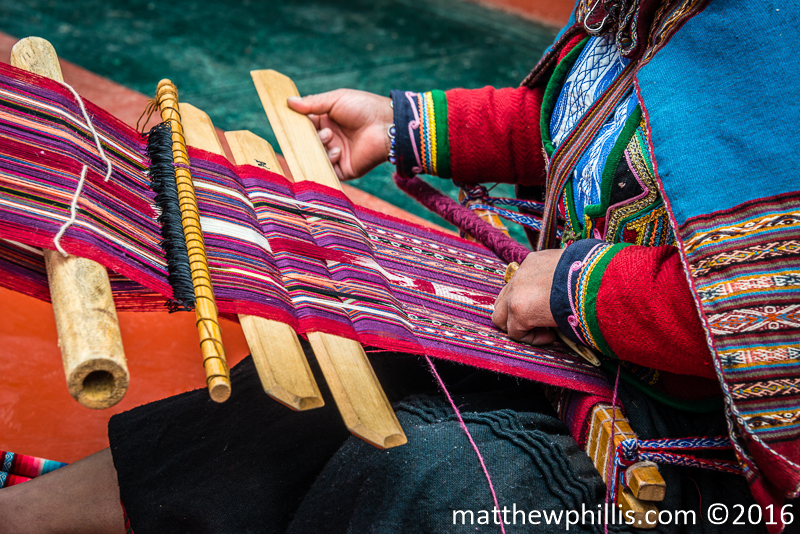
The last thing on the list of things to do here before heading off was a small town just outside of Cusco. At the local workshop a group of ladies make the colourful and traditional clothes that you see all around the country. All made my hand, they use natural dyes from local ingredients. The woman who was doing the demonstration had great English, and explained how they made it and how the whole community was involved and that the money goes back to the town. Llama wool is used for these clothes - first it's washed in natural soap, then dyed and hung out to dry. We were served 'munya' tea while we watched and listened, but most people were too interesting in watching a little 7 year old girl, all dressed up like the adults, making clothes. Aftegr the demonstration people wandered around and took photos, but very few people bought anything as everything was quite expensive - a long shawl cost 300 soles ($120). Beautiful but far too much for my limited budget. If only I could buy all the beautiful things that I've seen along this trip - fistly I wouldn't have the room in my bag, even if I bought a new one, nor would I have any money left. I will have to make a special round-the-World trip just to go back to these places to shop! A good day out, and a good farewell to Cusco too - I felt that I'd done a fair bit here, and not just Machu Picchu.


Thanks for visiting, come back soon!

Sunday, 24 April 2016

The Road To Machu Picchu

The mountains and valleys around Cusco.
A llama in Cusco.
This is my city!
I felt quite at home in Cusco, as much as you can in a foreign city full of tourists and locals peddling souvenirs and other trash. The city is beautiful in the centre, and interesting on the outskirts, where you can wander and see the real city, the locals going about their normal business, eating at local restaurants and just being Peruvian and their lives not centred around tourist dollars. I was lucky enough to enjoy some of this, eating cuy (guinea pig) at a local restaurant, walking around the cemetery, which I always enjoy in South American cities, and also seeing parts of the city that most people don't see. Although my plan is to finish my trip and head onto Europe to work and live for 2016, I was actually tempted to stay here in Cusco. It happens sometimes, where you find a city that you love and feel comfortable immediately - Bariloche in Argentina is one example, and Sucre in Bolivia was just like that too. I knew this didn't make sense - I was on a tourist visa, I had many places to see and visit on my list here, as well as people waiting for me in Europe. Sometimes it's nice to dream though, and you never know, maybe one day I will come back and run a photography workshop and do a bit of teaching as well.


The winding river and the even windier road.
Yes, we crossed that in the van.
The bridge over the river leading to Agua Calientes.
The trip to Machu Picchu had been booked, and my friend Laurel was doing it with me. Although the tour operator who sold me the tickets was confident, I was slightly worried about the roads. February is still the wet season here in Peru, and it had rained in Cusco nearly every day this week, and some other travel agencies weren't selling the car part of the trip due to the condition of the roads. People in the hostel that had recently returned were recounting their 'terror stories' to anyone that would listen - the roads are completely destroyed, we had to change vans several times and pay more and we didn't think we were going to make it, blah blah blah. Nothing about the city that is on everyone's bucket list. You can't worry about what you can't control, so I walked away from the complainers and got my last bit of the city before leaving the next day. The bus picked us up early and we packed in with loads of other people - the van was full and headed out into the mountains towards Machu Picchu. About 4 hours of driving through beautiful mountain passes and gorges, we arrived at our destination - with one problem. The road that normally takes you to the Hydro Station and on to the town of Agua Calientes, had been wiped out by the river. All along the drive we could see this river raging, dragging logs and everything else with it, nearly breaking it's banks. Several roads were slightly damaged, and the workers were doing their best to keep them open, but this was too much. We jumped out of our van and crossed a slightly wobbly wire bridge to get in another car to take us the next 18kms to the power station. Some people complained about this, the change and also having to pay another 5 sole ($2) for the other driver (as our company couldn't go over the river, and this company was stuck on this side... a pain to pay again but it's nobody's fault!), but it's one of those things so I paid and got there ok. Some of the people who got angry about the whole thing got out... not sure if they walked or argued with another driver, but you're better off without these people anyway.


Bromeliads growing everywhere.
From the power station, there was a 2 hour hike along the train lines to the town at the bottom of Machu Picchu. I'd seen pictures of the town, and I knew I wasn't going to be impressed. The walk was pleasant though, apart from the fact that there was no path, and so we had to walk along the stones around the rails, or on the rails themselves. You can see the tops of some of the building in MP from here if you know what you're looking for, but like most people I didn't notice but saw it on the way back. All along the steep and very, very high cliffs that soar above the railway line and river, bromeliads are growing, covering nearly every square inch of the 90 degree cliff face with their spiky leaves and red flowers.  We arrived in Agua Calientes a little hot and tired, but before sunset. I immediately took a dislike to this town - it's sole purpose is to feed tourists with crappy expensive food, sell them souvenirs that they don't need and to give them a lousy bed for the night. It looked faked and felt fake - locals touting for restaurants and massages and then some. With our booking we had our first dinner and both night's accommodation included, so at least we weren't hassled too much or didn't have to worry about finding anything. The meal was average as expected (and a set menu with no choice) and the hotel was unfinished and smelt like paint still. It didn't really matter, tomorrow was Machu Picchu day - something I'd been waiting for for nearly 20 years! Bed early as it had been decided that we would start the hike at 4:15 in the morning to get to the top of the mountain and in the city by 6:30am. I was praying to Pachamama that it wouldn't rain!


The train to Agua Calientes.
A guy and 'his dog' on the hike.
The river (really) wild.
Maybe she only listens to locals during Carnival, as it was raining when we woke up and didn't stop till about 11am. The hike wasn't fun - 2 hours of steps leading up through the humid and wet jungle to reach the entrance gate. Some people took the bus, but we decided not to due to the price (can't remember exactly but somewhere near $15) as well as the fact that I felt I had to do some kind of exertion to get there - some people did the Inca Trail hike, which costs and arm and a leg and needs to be booked months and months in advance, and there is that sense of accomplishment. I was only doing 2 hours, but it did the trick - getting to the top and sitting down to admire the view and what you've just climbed was worth it. We amongst the fiest groups to enter, but already the place was packed - plastic ponchos and brightly coloured umbrellas everywhere. My photos weren't really ruined by these those, more by the weather. There were people everywhere, standing around in the rain, taking pictures (and loads of selfies), trying not to think about the rain, and only somewhat listening to the guide rattle off facts and figures like a machine-gun with unlimited ammo.


The beautiful and mysterious Machu Picchu.
A few clouds for effect.
Water channels in the city.
We we able to leave our tour guide after an hour as we had tickets to hike up the bigger peak just behind the city called Huayna Picchu (meaning "young mountain"), which would offer a view over the whole city. An hour of hard climbing and buckets of sweat later, we were again surrounded by people and yet weren't about to see what we can to see. I was starting to feel a little disappointed. You have high hopes for something, a place that has been on your Top 5 list of places to visit for so many years, everyone says it's amazing, and then when you get there it lets you down a little because of the weather and lack of visibility. If it were a city or something more accessible, I wouldn't have worried so much - come back when the sun is shining in a day or two - but I would only have one crack at this. Climbing back down a little under the (cloudy) weather, We found a spot a little lower but with an even better view - and the clouds were starting to pass over. Things were looking up. I was happy to sit there for a good hour, watching, taking pictures, and enjoying the moment - the only chance most likely of seeing this wonderful place in my lifetime.

The housing area of Machu Picchu.
Selfies all round!
I was one of thousands of tourist here on the day.
The city of Machu Picchu is full of mysteries and one can only guess at some of them. Built in 1450, the city was abandoned 100 years later due to the Spanish invasion - but the invaders never found this place, and it was 'lost' until Hiram Bingham, an American historian, wrote about it in 1911. Machu Picchu means "old mountain" in Quechua, and sits 2,430 metres about sea level with a commanding view of it's surroundings, including the river and the path that I walked along to get here. As I walked in along this path, I didn't see the city even though I knew it was there - no wonder it stayed hidden for so long. It was declared a UNESCO in 1983 and was voted one of the New Seven Wonders Of The World in 2007. Today is is visited by around 5,000 people A DAY in the low season, and a whopping 9,000 in the peak season. This has caused problems with the site - in the 80s a helicopter knocked a stone from it's original position, in the 90s a cable car to the top and a luxurious hotel was going to be built, but thankfully due to protests the plan was abandoned. Even deaths due to altitude sickness, falling floods have been issues, as well as "naked tourism." For some reason people see the need to get starkers at great sites around the world. Our guide said due to the sheer amount of people coming here daily, the city was sinking, and thus the Peruvian Government are putting restrictions on the amount of people visiting and time spent on the site - glad I got in when I did, as I spent nearly all day there, free to wander. Something to note about how much money the site brings in for Peru - minus the train, town revenue, entrance fee and food and drinks sold, the WCs cost 1 sole, which is nothing, but multiply that by 5,000 a day and you have nearly $2000 ($3500 in high season) just for people taking a wiz at a historical site.


Those stones fit so well that a blade of grass cannot fit between them.
Beautiful stone windows.
The view down the valley.
There are so many parts of the city to describe and talk about - where to start! The Inti Watana Stone is very interesting - it is part of the Sun Temple and has windows which are used to show the Winter and Summer Solstice. Through these windows, perfectly lined up, the sun on these two days shines through exactly, hitting this stone. The sun also shines on the 12-sided half "Inca Cross," with the shadow forming the other half along the ground. There are approximately 200 buildings here, some just houses for the 800 permanent residents that lived here, others to bring water into and around the city, and some for religous purposes, like the Sun Temple. At the bottom of the Sun Temple there are two small, round stone "bowls," which, when filled with water, are used to view the reflection of the start - beats straining your neck all night. Not all of the city has those perfect walls that everyone is used to seeing - this kind of craftmanship is saved for the important buildings, not Tom Dick and Harry's house down the road. It is kind of like the Romans - not all of Rome was built in marble, as that is just too damn expensive, so they built the city in brick and used marble as a façade over the top for beauty. Brilliant and cost effective! The Inca style is still very impressive - a technique called "Ashlar," is used to make the walls, where large stone blocks are cut and fit together without mortar. These joins between the walls are not always logical or straight, small curves and 'L' shapes are cut into them for some reason, but the joins are so neat that you can't fit a blade of grass between the two blocks. There was also an earthquake here, and very little of the city was damaged. 
The Sun Temple with Huayna Picchu in the background.
The Sun Temple - windows for the Winter and Summer Solstice sun.
After most of the day up here, and nearly all the photos my camera could take, I was about ready to head back down. I did walk around the site extensively, but had to follow a set path, and several times had the guards blow their little whistle and tell me that this path is a 'one way' path. Stupid, but good exercise. At around 3, the rain also came in and it was definitely time to leave. Last few selfies and photos done, we headed back down, via the expensive bus this time so we didn't have to walk back in the rain as well. Overall the experience was a little less amazing than I expected, but then again I'm not one of these people who say "that was soooo amazing!" all the time - I can be honest and grade things slightly, not everything has to be 'the best experience of my life.' In saying that, it was cool and definitely worth it. The weather the following day was perfect though - blue skies, a few clouds to help make photos more interesting, but you take what you get in life and be thankful that you did what you wanted to in the first place!

The beautiful views around the Machu Picchu area.

Remember to also follow me on Instagram at:

MyUncleTravellingMatt. February 2016.

New Zealand Southland - Part 2

 Live the van life while you have it – no regrets The landscape on the South Island is simply stunning The view from Mount Cook road This wa...