Saturday, 28 September 2019

Gem of Europe

The beautiful city of Prague - a true Gem of Europe
Strahov Monastery.
On guard at Prague Castle.
Easter break this year was a longer wait than usual. Normally it comes either the last week of March or the first week of April, but this year we had to wait a little longer. This term is always hard for teachers, you've just got back from Christmas break, having had lots of public holidays in the first term as well so it feels you haven't even really started, then comes Term 2. A real desert of a term, no public holidays to be seen, no 3-day weekends, no respite until the promised Easter Break and beautiful holidays! Flights need to be booked well in advance, plans on where to go organised and thought about thoroughly. Somewhere warm yet not too hot, close but a little exotic, and cheap but exciting. Last year I visited Ireland, Dublin and Belfast, and while I had a great time, I wasn't warm nor cheap. Ever since summer last year, plans had been forming for the next break, and I was leaning towards the Czech Republic. I hadn't been here since way back in 2008 when I was driving from London to Milan in my van, having worked in the UK for 3 weeks and then heading down to Italy to start a new teaching year in a new country. I visited Prague and by a lucky stroke of luck (after walking past a travel agent and seeing a poster) also visiting the magnificent city of Czesky Krumlov. So plane tickets were booked, accommodation researched, and my good friend Teresa contacted as I hoped to meet up with her in her home town - we hadn't seen each other since she visited Barcelona in 2016 and before then in Sydney in 2015, so it had been a while. This trip was forming up to be something great - a re-visit to a beautiful and interesting country, a chance to visit a good friend whom I hadn't seen for years, and the first big trip with my girlfriend.
Prague's castle square - and the queue to get in.
Prague's Old Town is typical Central European architecture - stunning!
The walk past the castle walls to the centre.
Domes and towers are everywhere in Prague.
Prague, as everyone knows because they've visited it or because it's on the list, is a beautiful city, a real archetypal Central European city. With hundreds or churches, spires, stone bridges and buildings, century old clocks and cobbled streets, you can't help but to fall in love with this city. Known for these things, its architecture and history, Prague has also been a city for Stag Parties and pub crawls for Europeans, popular with the Brits and Germans due to the cheap price of beer and budget flights. Sadly, over the past 10-15 years, the situation has been getting worse and now the government is trying to crack down on drunken, disruptive behaviour that tourists are bringing to the city. This is something that is happening a lot in Europe, and Worldwide too I'm sure - too many tourists. Barcelona struggles with the double-edged knife - on one hand, you have millions of tourists coming to your city, spending money and helping the economy, yet on the other hand, the cost to the locals way of life, traffic, prices and overall state of the city (more tourists = more rubbish and pollution). So what is the limit, the line to be drawn, and then how to you enforce it? I knew that Prague was going to be very busy in April, but less so than when Summer would be in full swing and everyone taking their August holidays, so I decided to face the crowds and visit as maybe it would be the last time for a while. Although I'm also a tourist, I don't like fighting crowds, being part of huge queues to see some tourist attraction or pay more money than I should simply because I'm a tourist. On the other hand, I don't always say I'm doing it 'like a local,' the typical traveller's catch phrase now. I try to get off the beaten track, as much as possible, but I also like the road well-travelled as there are reasons why lots of people visit a city or country. I try to taste the local food, but do not call myself a 'foodie,' but also don't pay a lot for these things, as you don't have to spend a lot of money to enjoy the simple things in a place. Anyway - Prague, here I come!
Prague Castle from Charles Bridge.
The castle seen from Aussichtsbank park.
Prague in Spring!
Morning walk.
An early morning flight allowed us to land in Prague and grab the train to the city then a tram to where we'd be staying for the next 2 nights. We landed to cloudy weather with a touch of drizzle, not the most promising weather for a holiday. Like most people, apps had been checked every day, or several times a day, and then checking them on arrival too. Both of my apps promised nice weather by tomorrow, even clearing up this evening. This is enough for me - and usually even without modern tech like this, I'm positive about the weather and that it will be just fine! I have to say here that the weather for the whole week was amazing - warm and sunny, with not a drop of rain to be had after the first day, unlike Barcelona at the same time where it was cold and even had some rain. Positivity wins. As we couldn't check in until 3, we decided to have lunch and our first (of many) beers in the country to celebrate the start of Easter Holidays. A 5 minute walk to our accommodation and also right in front of the tram stop where we got off, we found a cosy little Czech pub, with a few locals drinking and chatting, but more importantly, mouth-watering smells coming from the kitchen. This is where we had some lovely Czech soup and bread, warming up from the inside, as well as relaxing with some great Czech beer. I have to say now that my whole time in the country, I found coffee very expensive - far more than beer. An average beer would cost you around 25-50kc (€1 - €2) for a pint, whereas coffee was at least 50kc, sometimes up to 120kc the centre (€2 - €4.6and not that good. So we just had to drink more beer - easy. We checked in with our host, the room was a decently sized studio-style apartment, with a shared bathroom with one other couple. We had a small kitchen, a fridge, air-con and a window - it was pretty good and very reasonably priced too! A quick shower and change of clothes before we headed out into the city for sunset and our first real exploration of the city.
The Vltava River that intersects the city.
Walking across Charles Bridge.
Walking by the castle walls.
30 statues adorn this beautiful bridge.
Walking down into the city, you can't help but notice the wonderful architecture here - the buildings all have something about them. Their pointy roofs, cute shuttered windows and the 'eyes' in the tiled roofs, all very Central European. The hostel is minutes from the centre, so before long I was looking right at Prague Castle, sitting up it's hill with the best panoramic view of the city it was built to protect. Build in the 9th Century, this castle has some history, that's for sure. It is not the official residence of the President of the Czech Republic, but has been the seat of power for the many people previously, including the Kings of Bohemia, the Holy Roman emperors and the presidents of Czechoslovakia. According to the Guinness Book of World Records, it is the largest castle complex in the World - 70,000 m2. It is also the most visited tourist attraction in Prague, with more than 1.8 million visitors annually. This would have to be the reason I have never visited the castle - there is always a huge, snaking line outside, winding its way around the square in front of the building, all tourists waiting to pay the over-priced entrance fee. Prices start at 100kc and add up in increments depending on what you want to see, including a fee for taking photos, which I hate paying and always refuse. I gave it a miss back in 2008 and did the same this year - I think the real beauty of this castle is either the view it gives and how you see it from the river and the rest of the city. Anyway, in my opinion it is no longer really a castle, more of a palace complex with a church in the middle. This is probably due to a large fire in the mid 16th Century and damage during the Bohemian Revolt in 1618 and during the 30 year war (which ended in 1648). I'm much more of a stone walled castle fan anyway, so I don't feel I'm missing out on much.
Prague on the river.
The priest that was thrown off the bridge - now good luck to touch the bronze plaque.
The crowds on Charles Bridge.
Polishing the broze.
What everyone comes to see (and walk over) is the Charles Bridge, which joins the castle side of the city with the Old Town and cathedral side. Crossing the Vltava River, the Charles Bridge is just over 600m long, not too bad for a 14th Century stone bridge. Construction started in 1357 to replace the older bridge that had been damaged  by a flood, and was at first called Stone Bridge (Kamenný most) or Prague Bridge (Pražský most) but has been "Charles Bridge" since 1870, named after King Charles IV who started the project. Up until 1841, it was the only way to cross the river, making Prague a key connection between Eastern and Western Europe. The famous statues that line the bridge on each side, 30 in total, are also a main attraction, very impressive 18th Century Barroque statues which have been replaced by replicas. Most of the statues are of saints, one of note is of St John of Nepomuk, a holy looking figure with a halo around his head, but more interesting than this is the bronze plague below depicting someone being thrown off the bridge. Legend has it that St John was killed upon the King's request as he refused to tell him the Queen's confession - in fact he brought an enemy of the Kind into the city, but he was thrown off the bridge. It's good luck to touch the picture and it's supposed to ensure you visit Prague again soon - obviously a load of rubbish but one nearly every tourist can't pass up, forming a queue to do this and polishing the bronze at the same time. There are many other stories behind the sculptures, and every one is interesting in some way. We were very lucky, as the bridge is due for some repairs later in 2019, so it was the right time to see it as it is before they cover it over and do who knows what to it for the next 20 years (yes, the scheduled repair time!). It's not easy walking over the bridge, its 10 metre wide walkway isn't nearly wide enough to handle the amount of tourists, wandering and stopping randomly for photos and selfies or the check out the small stalls. If you want to cross the river and get into the city quickly, this isn't the way, but you have to do this walk, at least twice (during the day and sunset) if you come to the city - it's a must, no matter how many other people are doing it. Enjoy your time, walking slowly, get your photos in, then get off before you get sick of the pushing and crowds!
The main face of the clock.
Prague rooftops.
Everyone's favourite - the skeleton.
The second face of the Astronomical Clock.
I loved wandering the streets of Prague, even though very few of them were tourist and crowd-free. There is always something to look up and see, or even in some cases, look down where your feet are. Small wonders are everywhere if you have an eye for them. Something that everyone sees, and in fact one of the reason they come here, is to see the astronomical clock in the town centre. Prague Astronomical Clock, or Prague Orloj, is a medieval clock that was installed on a tower of the old Town Hall in the centre of the Old Town way back in 1410, making it the 3rd oldest Astronomical Clock and oldest, still functioning clock in the World. I'm not sure where to being with describing this amazing piece of engineering - there are 2 clock faces, the top one tells the time as well as the position of the sun and the moon. There are indicators for night time, day break, sunrise, day time and sunset, all with mechanical hands and coloured parts of the face. Around the outside there are Roman numerals to show the modern 24 hour clock, but there is another ring showing Ancient Bohemian Time. The second face, the calendar dial, was added in 1870 showing the Zodiac symbols and marks each day of the year. Most people can't read the clock (I got my info from a website with a lot of detail) but don't come here to tell the time - they come for the hourly "Walk of the Apostles."Every hour, on the hour, the clock gives a wonderful, if short, show of moving figures, chiming and bell striking. The are 4 figures, Vanity (holding a mirror), The Miser (holding a bag of gold), the Skeleton (representing Death) and then The Turk who represents pleasure and entertainment. The skeleton is everyone's favourite and he chimes out the hours, but you have to watch everything and not focus just on him, as above march the Apostles through little blue doorways. The whole show is very impressive and it brings masses of people to the square, all standing around like fish out water trying to flies while holding mobile phone sup to video everything. You can take a tour and go up the tower, but again there were a lot of people and it wasn't the cheapest, so I gave it a miss and enjoyed the tower from the ground level.
One of the many tourists who pack the square in front the clock to watch its hourly show.
The astrological clock and the Church of Our Lady before Týn in the Old Town.
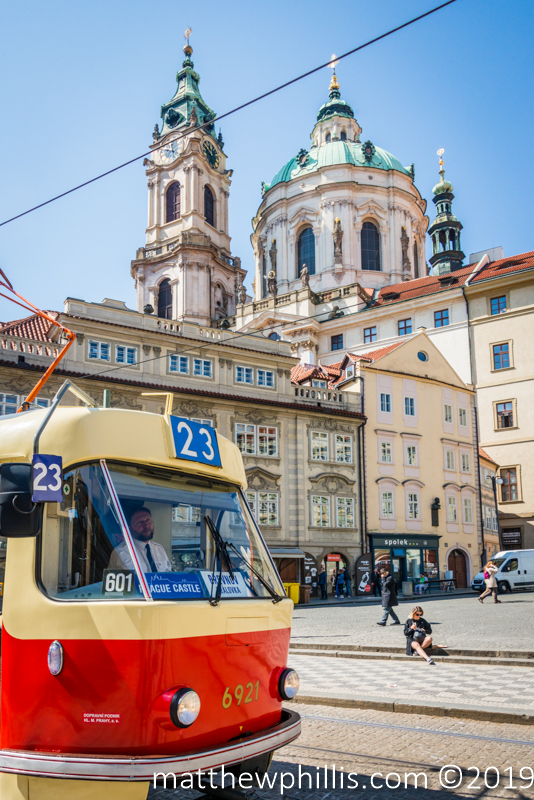
Trams are always fun!
Prague has many parks and gardens.
So much to see in this beautiful and historical city, and as always, so little time! There was a little time to walk around the city before getting the train to our next destination in the Czech Republic. We made the best use of time by checking out early, after a quick breakfast, walking down to the tram stop and getting a tram to the railway station to lock our bags up till we were ready to board our inter-city train. We bought our evening train tickets, for only 100Kr (€4), and headed out again. Bag-free, we strolled around to see the parts of the city we'd missed and to also relax a little from walking and enjoy the fantastic weather the city was experiencing. The tram itself is something you should do while here too, try and catch the really old ones for the real, bumpy experience. I've always found trams very exciting for some reason - is it because I never had them as a kid, trams only being in Melbourne (and very recently in Sydney, but they're not the same), or is it because it's just very European? Buy a ticket on board, ride the line, enjoy the sights and try not to look too much like a tourist - some people actually use trams every day to get to work and go home. Our last day in Prague before moving on was a bright, warm and sunny day, so we grabbed some food and had a picnic in one of the many gardens in the city. A bit of time chilling is always appreciated in the warm weather, and helps you relax, gather your thoughts for where you're going next, and very importantly as well, help you appreciated just exactly what you have here and now. We made the train in plenty of time, got our seats and enjoyed the 1 hour and 45 minute train journey to Hradec Kralove.
The Národní muzeum.
One of the many parks in the city.
Remember to also follow me on Instagram at:

UncleTravellingMatt. April 2019.

Wednesday, 28 August 2019

Barcelona Beaches

Beautiful Barcelona.
Beach time.
Boast on the beach.
Spring in the city had sprung and the fair skies and good weather is now something you can depend on every day in Barcelona. Apart from the occasional Spring storm, which brings a lot of rain in a short time, impressive thunder and lightning, as well as cooler temperatures, the city is fairly hot from April and May all the way through till September. I hadn't done much hiking since January, just a trip to Nuria and La Mola, so I figured I'd head to the beach instead and get some sun and sand instead. Although not famous for its beaches, Barcelona does have them and they aren't too bad for city beaches. Nothing to compare to the one further up the Costa Brava, or Sydney's wonderful beaches, they are basically the same - sand, (some) waves and a good way to get a little bit of a tan on the weekend. I decided to get the Renfe train to Sant Adria del Besos, a neighbourhood in the North of Barcelona, and walk back along the promenade all the way to Barceloneta and the small beaches within walking and metro reach of the centre. A little bit of history about the beaches of Barcelona though, that is quite interesting. Before the 1992 Olympics, most of these beaches didn't exist! The 2 miles of beach was created, using sand imported from Egypt, replacing mostly rocky shore, ugly, abandoned buildings and shanty towns. To think that this area is now so important and a symbol to the city, and not that long ago it was pretty much an industrial dumping ground and wasted, ugly space!
The power station at Sant Adria.
Silent chimneys.
Power station on the sea.
Barcelona is very popular with tourists.
Sant Adria del Besos isn't the most beautiful or exciting 'barrio' of Barcelona, and isn't visited by many tourists. The train was mainly full of locals heading to the beaches, slightly more away from the city and the crowds, but still within sight of the city in the distance. There isn't much to see apart from the beach as the area is mainly industrial service sector buildings, small manufacturing, transport, recycling and power generation, historically full of migrants due to the work here. One thing you can't miss here is the old Besos Thermic Power Plant with its 3 tall smokestacks dominating the landscape. Built in the 70s, it was controversial right away - as you'd probably agree if you saw it, a huge concrete box of a thing with 200m chimneys reaching for the sky. It's basically impossible to miss. During its operation it caused a lot of pollution, black rain and smog, that made cars, buildings and clothes out on washing lines dirty, not to mention what it was probably doing to people's health. Thankfully, it was torn down in 2008 due to many and prolonged protests from the locals and now it sits there, a symbol of the past, the industrial power of this suburb and its migrant residents. It's also very popular with photographers and it's even appeared in some music videos. As much as an eye-sore that it is, big, ugly and concrete, I kind of like it for its artistic value, including some very interesting and colourful street graffiti on the walls, and enjoyed taking a few pictures of it before heading down to the beach. The beach and walk is quite pleasant though and as you walk along the promenade, you get the sea breeze and view of the Mediterranean and as well as the bigger buildings of Barcelona in the distance. Another spot a lot of people stop at is the Pont de Petroli, or Petrol Bridge, a long pier that is a good place for a photo and view back towards to the shoreline. This 'pont' is very popular with Instagramers too.
The 'Pont de Petroli.'
Barceloneta beach time.

The W Hotel at Barceloneta.
The walk along the sea at Sant Adria.
Reaching Barceloneta means more and more people, all trying to get their piece of sand to lay on and get some sun. There are always people here when the sun is out and sometimes it's real struggle to get your patch of beach. Most of the people here are tourists, who can easily walk from the Metro station, grab a drink at a nearby xiringuito (beach bar) or some tasty seafood at a beach-side restaurant. Sadly, when you do get a space, it isn't relaxing for long - hawkers are selling their wares, whether it be beer, mojitos, massages or selfie sticks, calling out and doing their laps, back and forth, all-day, non-stop. You try and ignore them, usually I can't help saying 'no thank you' to all of them, but even I stop doing this or you'll never get any relaxation. There is drinking and smoking on the beach as well as paddle games and football - all very Spanish. This is the busier and more touristy beach, and if you want peace and quiet, then this isn't the place for you. Instead, you'll get the real beach-vibe of Barcelona - people selling FCB shirts, fake Gucci handbags and Prada shoes, saris and all sorts of souvenirs, as well as constant traffic on the walkway next to the sand, bars and people drinking and talking, all a short distance from the W Hotel and seafood restaurants - what more could a tourist want right? This quickly gets too much for me, the amount of people, the fact that you can't walk anywhere without nearly stepping on some vendor's crap (as they've taken over whole footpaths), so I usually walk for a bit, take in the sights and get a few photos, then head into the barrio for a beer and some tapas as a little local bar (which shall remain nameless in the hope of keeping it a secret).

View of the city from Sant Adria.
The start of the walk in Vilanova.

Following the path.
Gay Paradise since 1930.

If you still want more beaches, and maybe even another walk with beaches, then get on the train and head to Sitges. Famous for the 'gay scene' as well as its film festival, its a busy and lively place to visit, during the day and the night. They also have a great Festa Major, the annual Catalan party that is held in nearly every town and city across the country during the Summer months, a 4 or 5 day weekend of music, beer, cultural events and good fun. I wasn't here for any of these thing today, instead I came for a walk with my girlfriend along the coast then some relaxing time at the beach. We decided to start at Vilanova, one more train stop south, start from there and make it for a late lunch in Sitges. The weather was great - blue sky, a few clouds to make it more interesting, and just good old Spanish warm weather! Ready for a walk! The path was a little hard to find as there weren't many signs, but once found it was easy to follow. Little more than a dirt train in some parts, the path follows the railway lines for most of the way, occasionally dipping off closer to the coast or climbing some of the rocky outcroppings to give a spectacular view of the sea. Not difficult or long at all, it's something that everyone could do, and should do - an great way to spend half a day walking, getting out in the sun, smelling the sea breeze, a train ride and also ending up in a cool place like Sitges. Along the way, apart from the great sea views, we spotted a big rainbow gay flag waving in the wind, and I know that Sitges is known for its Gay community, I wasn't sure what this flag was doing on a rocky hill in middle of nowhere next to the train line. Upon further inspection, we found a sign stating the this beach is "Gay Paradise" since 1930 - the World's first gay beach - and there was also a beach bar (xiringuito) called "Xiringay" which was established in 1970. From a higher vantage point we also discovered that it is also a nudist beach. After a little thought, I decided it better to finish the walk before having a swim, as I would only get sweaty and dirty again.

The walk from Vilanova to Sitges.
There is history in Sitges.
The Cau Ferrat Museum.
Sitges.
Reaching Sitges in the early afternoon, it was time for a sit down in the shade and a cold beer. I must say something about the city first. As much as I love it, its freedom to be open and be who you are, its proximity to Barcelona and have its own beaches, it is a tourist trap. To make things worse, the hotter it gets the busier it gets here. Night does not bring any respite as that's when the nightlife starts. It's 24-7 here in Sitges at the right (or wrong) time. The first place we found served us beer on the terrace, but told us that they don't accept cards. Finding this hard to believe, I went inside to ask at the bar and I told that it was 'cash only' here. I looked around at the restaurant I was in and couldn't keep my mouth from dropping - it was full of people having lunch, drinking, having a good time, but all paying cash. How could they run a business this way and how can so many people be just paying cash? So, not having any cash on us, we ran. Serves them right for telling us the stupid rule only after bringing the beers. Beers were bought at a convenience store, along with some snacks, and a place on the beach found - relaxing time was achieved. Walking around the city is also very pleasant - its small but very beautiful. It has the typical white-washed buildings of Catalan coastal towns, small stores selling expensive jewellery and bars and restaurants packed together, all trying to get the best sea view. The church that is the picture postcard of Sitges is the Iglesia de San Bartolomé y Santa Tecla, perched up on the outcrop hanging out over the sea. The stairs are always full of people taking pictures of this beautiful church (and themselves... and sometimes themselves and the church), and it has a nice little bench where you can sit and take in the views with the sea in front of you and the church directly behind you. There are a couple of museums, but most people just walk around the Old Town as well as the Passeig Maratim. I was happy with that and some beach time - not so with the crowds on such a hot day. If you like crowded beaches, expensive bars and thumping nightclubs, then this is the place for you in August!
Sant Adria from the Carmel Bunkers
Barceloneta beach.

Barcelona from the bunkers.
Els Bunkers - a romantic place to take her.
If the beach isn't for you, there's still plenty to see and do in Barcelona before it gets too hot. One of these things are the 'Bunkers de Carmel.' These Civil War installations that served as (yup you guessed it) bunkers to protect anti-aircraft guns. They later became a shanty town, the last in the city, but with the coming of the Olympics, the residents were offered new apartments in the city and so moved out. This left the area free and is now a very popular destination for people to come and get a spectacular 180 degree of the city that is Barcelona. It's not that hard to get here, although there isn't a direct metro line, it isn't that far to walk either. Hey, you can't expect a fantastic hill top view without walking up a hill! I had some champagne (or cava in Catalonia), supermarket tapas including bread and humus, and spent a lovely afternoon with the girlfriend, enjoying the view, having a lovely conversation and just being happy to be where we were. I also brought my camera of course! If you get a few days in Barcelona, or you live here and have never been here, then put it on your list - it's free, outdoor and  great place to come and see. It gets quite crowded up here, but they're not all tourists, many locals also love the view and use the time here to chill, enjoy a drink or two with friends and listen to some music played by a weird guy with a guitar. There is so much more to this city than just beer, tapas, FC Barcelona and trendy nightclubs, you just have to look... or ask a local in the know.
There's always one...


Uninterrupted views of the city.
Remember to also follow me on Instagram at:


UncleTravellingMatt. April 2019.

Monday, 12 August 2019

The Nuria Valley

Hot Air Balloons over Vic.
The hike to Nuria.
The mountains are calling!
Christmas in Sydney was lovely, a chance to go home after nearly 4 years. I visited a few beaches, drove around old suburbs of Sydney were I lived and had many memories, as well as catch with some old friends and family. The weather had been hot too, some days tipping the scales at 45c in the city, driving people to flock to the beaches or stay indoors with their air-con on high. I had also visited a few beaches, some of my old favourites and places where I spent many hours lying in the sun, dipping in the water to cool off and rinse the sweat off being laying back in the sun to warm up again - nothing like Summer in Sydney. I'd ticked all the boxes of things that I wanted to do once getting home, most of these things were food that I had to eat - Vietnamese Pho, Thai Laksa, good old Aussie meat pies and sausages rolls, as well as a hot Indian curry. I spent one of my last nights chilling on a rooftop terrace bar in Newtown, having a few beers and talking dreams and aspirations with my best friend who I went to school with. This friend (she knows who she is), is one of the hardest-working, dedicated, smartest and interesting people you will ever meet and I am very happy we got to hang out while I was back. It doesn't matter how long between visits and chats, even if it's 4 years, it seems like yesterday - that's friendship. But not, it was time to make the 24 hours flight back to Barcelona, battle with jetlag and go back to work within a few days and teach 3 year olds. Bring it!
Anyone else see a baby? Looking at the clouds and seeing shapes - Pareidolia.
End of the ski season.

This way!

Nuria is also a ski resort.
The Winter in Spain and Barcelona hadn't been too cold and snowy so far, last year was much worse. I say worse, as I don't really like the dark, cold and wet days of Winter, but in Barcelona it isn't that bad at all. Also, I like a good winter hike if there's a bit of snow around! Since getting back here and going back to work, I was far busier at work and seemed not to have much time for day trips or any mountain trips at all, and it was starting to show. I was feeling the need for Nature, the call of the wild, to stretch my legs and hike. Luckily, many of my friends here feel the same, and so a trip was planned. Already it was March, and I'd been back since mid-January after Australia, and not really done anything, let alone in the mountains. We decided to head up to the Vall de Nuria (Nuria Valley), a Ski resort and monastery in a valley in the Pyrenees. There are 2 ways of getting there - walking from the town of Queralbs (or from France on the other side of the range) or via a rack railway. There are no roads, no short-cuts apart from the train but it isn't cheap to do it that way - unless your name is 'Nuria' then the ticket is free! It's actually a very popular name in Catalonia, but I'm sure not just for the free ride up here. I've caught the little train once as well as walk, and this time we would be walking as well, starting from the village of Queralbs and walking for just under 3 hours. It's fairly close to Sabadell, just over 1 hour and 30 mins on a good run and along the C-17, a road that runs through small mountains, past towns like Aigufreda, Centelles and past Vic. To make things easier, I had dinner at my friend's place, with their 2 kids, and slept on the sofa, ready to make an early start in the morning.

Mountain cabin with a view.
The start of the hike to Nuria.
The hike up.
Frozen water at the dam.
With a little napping and no traffic, the ride went by quickly, even the kids were quiet! Being a Sunday, you usually get to see balloons setting up in the area around Vic, and today we saw lots of them, all floating just off the ground, making their quiet ascent into the big blue sky. If you've never been on a balloon trip, I highly recommend it - it's peaceful, relaxing and you get amazing view straight down onto houses, roads and fields, and also a unique view of mountains. The landing isn't always quite so tranquil - it;s usually a bumpy affair and you rarely land exactly where you want either! We parked the car at the rack railway station, had a quick bathroom break and leg stretch, then slowly walked up to the starting point of the hike. Already at this time, around 8:30, there were people waiting for the train to Nuria, but not as many as you'd get in Summer or Winter. In summer, loads of people come up here to go hiking in the Pyrenees and sometimes right over the border to France. In Winter, it's busy because it's also a ski resort. Luckily for us, it wasn't peak season and there weren't that many people going either way, train or trail. We stopped at the entrance to the village, filled up water bottles from the mountain spring fountain and also had a small snack of croissants and pastries to get some energy and motivation to start. We had 3 kids with us and with kids, you need to stop and feed them, rest them a little, every 45 mins to an hour to get to the finish line - they can do it, kids have an uncanny ability to always have a secret reserve of energy which they let lose at the wrong time, usually in the car on the way home, but they need stops and encouragement to hold their interest. Adults either need to be in shape or be mentally tough (sometimes both) to keep going, relying on muscle and training - kids just need to be kids.


The Rack Railway train making its way through the mountains.
As cool as the train is, you don't get these views without walking!
The Rack Railway.
The steel 'teeth' that help the train up the slopes.

We hiked up, stopping a few times for snacks and water, as well as photos. It didn't quite take up 3 hours, although it's quicker without kids. The view gets better and better, the higher up you get and further along the path. You cross small rivers, go under the railway bridge, and wind your way up and through the mountains, occasionally getting a brief view of the rack railway train steaming up and through the tunnels, cutting out all the twists and turns we had to do. The Vall de Núria Rack Railway, or the 'Cremallera de Núria' in Catalan, was originally opened in 1931 as an all-electric train to access the ski resorts which up to this point was only accessible via footpath and donkey. The train operates normally for some of the way, snaking up the railways, through tunnels, but the last part, the steepest part, it goes up via a strange rack system. This part of the track looks like big metal teeth in the middle between the normal rails, and this links with the train and it gets pulled up the slope, even in snowy weather. The walk is a pleasant one, with great views behind you of where you started from, the green trees that change colour in autumn and even in Winter, blue skies and interesting clouds. The best part is when you finally reach the end of the hike, walking over a crest and you get a view of the valley and the resort. There is a small lookout point, where everyone goes to take photos and get selfies taken, but it's a must. From here you get a great view, and today we got exactly what we were hoping for - the was dam partially frozen over, as well as some remaining snow on the slopes and higher mountains. Beautiful! We walked down, alongside the water and over to the resort for a well-deserved beer and some hot food.


All aboard to Nuria!
The best view of Nuria.
Frozen lake.
The Vall de Nuria!
It's not just the ski slopes here that attract tourists, but the monastery as well. According to legend, Saint Giles came to the valley and lived here for 4 years during the 8th Century, but had to flee from persecution. He left a carved image of the Virgin, along with a cooking pot, a cross and a bell for calling shepherds to meals. A pilgrim called Amadéu began searching for the image in 1072 after having a dream. He built a small chapel for pilgrims, and eventually found the items left by the Saint and kept them in church as holy objects. The image is regarded as the patron saint of fertility by shepherds and the Sanctuary here is named after Saint Nuria. Inside the chapel, you can ring the bell while holding your head in a confession style booth, and the saying goes that  if you do this, you'll become very fertile and have many kids. I've done this a few times and thankfully no kids yet! We sat on the lawn in front of the monastery and ate our packed lunches, enjoyed the warmth of the Winter sun on our legs, and chilled out, not really wanting to leave. After a decent amount of time, and just when the sun started to lose its potency, we got up and started the journey back down to the cars. We had our last snack at the bottom along with more spring water, then a quick walk around the village of Queralbs, before jumping in the cars and heading for home. It was a good day - I love the Nuria Valley and love the hike there. Next time, I will not just hike there but further afield, through the Pyrenees, maybe even into France! Who knows! Adventure is just there on the horizon, take it and live it!


Rooftops in Queralbs.
The little streets of Queralbs.
Remember to also follow me on Instagram at:
https://www.instagram.com/myuncletravellingmatt/

UncleTravellingMatt. March 2019.

New Zealand Southland - Part 2

 Live the van life while you have it – no regrets The landscape on the South Island is simply stunning The view from Mount Cook road This wa...