Wednesday, 4 December 2019

Cesky Krumlov Love

Welcome to Cesky Krumlov!
Czech sunsets.
One of the most beautiful towns in Europe.
With our holiday in the Czech Republic nearly over, I was feeling was a little sad. But before going home, I thought a visit to one of my favourite places in Europe, and definitely in the CR, was in order. This place is Cesky Krunmov, a town 170 kms and about 2 hours south of the capital by car. We were still staying with my friend Teresa in Hradek and we decided to all go down together in the car and stay for 2 days. She had a gig doing some acting down there for a local festival and I wanted to go back and see this stunning town, so it was perfect. After she finished work on Friday, we packed the car and left. There was hardly any traffic and we got there just as it was getting dark, so we checked into our accommodation and chilled and went to sleep, ready for the next day of exploring. Before I talk about the town or what I saw I have to say a few things about the Czech Republic that I found weird but very cute and interesting. The first thing on this list is the sleeping arrangements they have there - if you have a double bed, as most couples do, you normally have a double (or Queen) cover to fit the bed, and you both sleep under it... but not here! People here like to have their own cover, so most double beds here have 2 covers... to prevent duvet stealing during the cold Winter? I asked about it and they think we're weird by only having one! Something else I found weird, but cute, was the fact that everyone leaves their shoes outside their front door, even in a a block of flats. Everyone also has a shoe horn there to help them with this little ritual. Food-wise, there are many things to enjoy here, but you should put the following things on the list if you want the real experience: 1. Trdelnik and 2. Goulash in bread. The first one, which is hard to pronounce, is a sweet that is sort of cooked like kebab meat, on a big, metal spit. It's a kind of bread but very sweet as it's basically just rolled dough covered in sugar and a walnut mix. It's traditionally sold at markets, but Prague and Cesky Krumlov being tourist towns, you'll see them everywhere here - just be warned that you will probably need some help to finish this large, sweet treat! Beef Goulash is delicious anytime, but at wintertime especially. Here is it traditionally served in a bowl of bread too - yes, the bowl is edible! Eat the soup, with pieces of your bowl, but be careful you don't get too greedy and munch too much of the bread too soon!
Spring time!
Wander the streets, discover something new.

Traditional Trdelnik - a must if you visit!
Easter eggs - Czech style!
The car journey was fairly uneventful and we arrived in the city just as the sun was setting. I wasn't able to see any of the castle or the tower, just dark streets. Our accommodation had already been organised by Teresa and we were staying in a monastery. This wasn't any old monastery, it was a very old one - 14th Century to be exact! Built in 1350 and first inhabited by monks 7 years later, who were later joined by nuns in 1361, it has gone restorations, additions, updates and finally in 2014 was restored completely to its current, beautiful state. We got a great tour given by Teresa, who explained the history and even some sad but interesting stories that happened within the same walls that we were staying in. The most famous story known here is one of a priest who fell in love with a nun. The two sides of the monastery are separated to keep the nuns and the priests meeting in corridors, but there are many secret passage ways throughout the building. This is one of the things that lead to the love affair of these two - they met and fell in love. When the higher authorities discovered this affair, they told the priest that she had died. So distraught with the news, he decided to end his own life. Just like Romeo and Juliet, he she wasn't actually dead but at the news of his death, she followed suit, thus ending their short love story. This story is a legend, possibly true, but the next story is fact. A man called Julius Caesar lived in Cesky Krumlov with his wife, who he'd had enough of and decided to kill her. One day he pushed her out the window, hoping to get rid of her once and for all, but she survived the fall, and made her way to her family. He marched up to her family's house and demanded her back. He made threats and finally threatened to arrest her father instead, so she eventually went back to him. Not surprisingly, all was not forgiven and Julius ended up murdering his poor wife and chopping her up into small pieces and even went as far as painting her bedroom with her blood. I don't know how it ended, if he got caught by the authorities or not, but they are both buried at the monastery.


City streets.
The best viewpoint in the city is no secret.
Take away only memories, leave only footprints.
Krtek and friends.
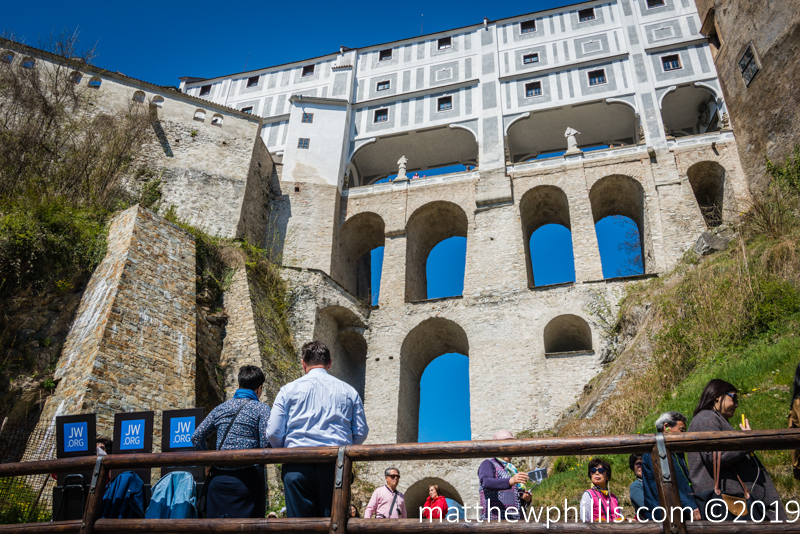
Český Krumlov, although only small, is a stunningly beautiful town. Situated in the southern Bohemian region of the country, it sits on a bend in the Vltava River and surrounded by lush, green Czech countryside. Its main feature and tourist attraction is the castle, but the historic centre was also made a UNESCO World Heritage Site in 1992, at the same time as Prague Castle. It was founded in 1240 by nobles and the fortress first mentioned in 1253, but I won't go into detail here and it only involves names of people that I've never heard of before. The important thing is that during the communist era, the town fell into disrepair, but after the revolution (1989) it was restored and has now become a huge tourist attraction, for Europeans as well as Chinese and Korean tourists. Asian tourist have flocked to Prague and Cesky Krumlov more and more lately, not just due to its beauty, but because of the Czech Republic's famous 1950s cartoon character Krtek. This character, a small, black mole with a bright red nose, has adventures with his woodland friends and for some reason is now very popular with Koreans. Souvenirs of 'Krtek' can be found everywhere here! The last time I came here back in 2008 there were already a large number of tourists, but this time, a little over 11 years later, there seem to be far more. I tried not to let that ruin the experience as we wandered the cobbled streets and enjoyed the beautiful buildings. Just walking the streets and letting your feet show you the way, you're able to see and do many things - don't follow a map or your phone, walk where you want, turn left or right when you see something interesting.
The river Vltava.
The beautiful Baroque tower in the castle.


A rare, tourist-free view of the town.
Ahoj Mr Bear!
Avoiding all of the stores selling tack (although there were also some great stores, albeit expensive), we wandered into the castle though the main gates. The castle dates back from the 13th century but the present-day castle is far more modern, a Baroque style after the renovations in the late 17th Century. Up through the big gates, there is a large courtyard and surrounding buildings, and the famous tower on your left. You are able to go up (for a fee) and you get a great view of the city, sadly something we missed as we left it too late in the day (they closed at 4pm). Something you don't see at castles everyday now are bears - but here this is one little fellow that was out and about when we arrived. I don't know the story behind the bear, whether it's a tradition or not like Bern in Switzerland, but he's a brown bear and lives in the castle moat. There is a big fence up and around the moat to stop silly tourists falling in and becoming bear breakfast, as well as signs with writing and pictures of what not to do, people do it anyway. We didn't go in any building either, and I'm not sure you can or who much it costs, but I was happy wandering and seeing what was around us. From the height of the castle you can see the whole town and the views are spectacular. Being a big tourist destination, most of the best viewpoints are taken by people wanting selfies and posed photos. This can't be avoided, but as I wanted a photo myself (not a selfie), I had to wait and get pushed a little (and push back), but it was worth it. There was one particular woman who was very intense with her selfies and took it rather seriously - she was getting other people to take photos of her as well, posing with silly hand gestures, and at one point I thought she was going to fall off the edge! There were many other people up there too, all trying to get their pics, some even posing in dangerous positions off the castle wall, not seeming to care about the 100 metre plus drop. Why worry, if you fall, you're sure to die and never have to worry about anything again... just another statistic of the growing number of deaths due to selfies. We moved on to the castle gardens for a snack and some open air away from the crowds. The weather was stunning - sunny and warm! A perfect place to sit for a bit, have a bite to eat and enjoy some quiet time.
The Selfie Queen at work.
Risk-taking for photos...
Time to go home...
Through the window.
Although there isn't much to do here, not as many as Prague for example, it's all about walking and seeing things. There is plenty to see that are just ordinary buildings but beautiful to see for example. Sadly, our time here and the Czech Republic was coming to an end. We'd enjoyed seeing our friend Teresa in her home town, revisiting Prague and coming to this gorgeous place. Before we left, we all went out to dinner together, had a few tasty beers and spent our last night in the monastery. This was one of the best holidays I'd had in a long time - relaxing as well as active, and catching up with friends. Early the next day we all got in the car and Teresa drove us to the outskirts of Prague so we could get the train into the city and then the airport. We took one last photo together and wished each other well and that we would visit again soon, maybe next time in Barcelona. For now, it was back home. Sbohem a děkuji!
Such a beautiful town... until next time.
Goodbye Cesky Krumlov!

Remember to also follow me on Instagram at:

UncleTravellingMatt. April 2019.

Wednesday, 30 October 2019

Train to Hradeck

Goodbye Prague!
All aboard! Next stop, Hradeck Kralove.

An interesting little find in Prague.
I just love train trips in Europe!
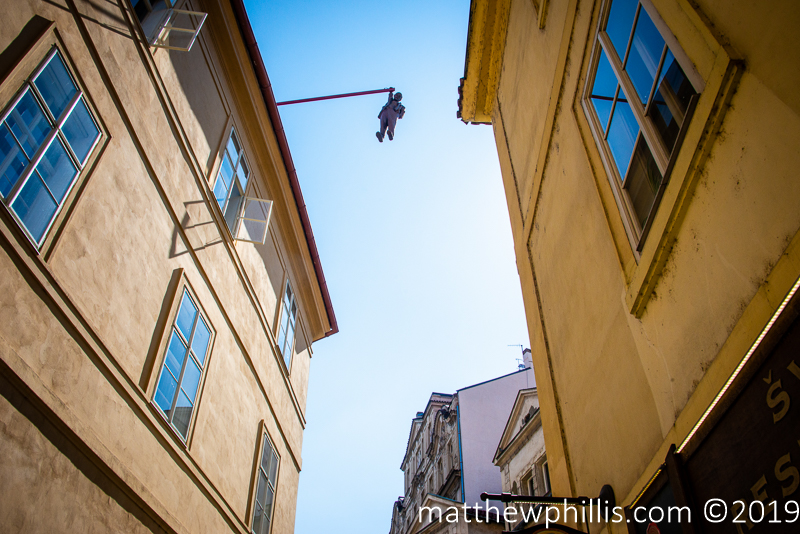
Prague had been very kind to us, showing us why it's famous for being a beautiful city. The weather couldn't have been better to be honest - the first day was cloudy and a bit rainy, but every single day after that was sunny and warm, even warmer than Barcelona was at the time. When exploring a city, it's important to follow the tourist trail if you want to see what most people come to see, and there's a reason why these tourist attractions are popular. Who wouldn't want to see the Charles Bridge or the magical Astrological Clock in the Old Town? A bridge that is over 650 years old and has beautiful statues adorning its stone arches, and the oldest astronomical clock in the World dating back to 1410 - you don't get to see these things everyday! There is the other side of the coin however, the crowds and tourist prices and tickets to see the 'top 10 things to see and do' in a city, so you should also head off the tourist trail a little, get lost, don't look at your GPS and just explore. Don't forget to look up! On my way through the city I noticed a few artworks, some literally 'hanging' from the rooftops - men with umbrellas, one man who looked like he was hanging on for his life (or was going to jump then changed his mind), as well as a very interesting and controversial one. In a small square on the castle side of the river, there is "The Piss Sculpture," with 2 bronze figures peeing into a small pool of water, which just happens to be in the shape of the Czech Republic. Installed in 2004 outside the Franz Kafka Museum, it caused a stir immediately. The two men move mechanically at the waist, angling their junk to pee in patterns - test messages to be more precise! You can actually send your own message via text message to a number (+420 724 370 770) and have them spell-pee it out for you.
The controversial statue that lets you 'pee' a txt message./
Hold on! Street art in Prague.
Views from the train.
Sunset on the train to Hradeck.
Sadly, 3 days in a city like Prague just isn't enough, but how could it be? I missed the Jan Palach Memorial, which is in front of the National Museum. It commemorates his act of protest of the Socviet invasion in '69 by self-immolation. I only read about this after coming back, but I'm sure there is much, much more to see and do (the 'Thief's Arm' included). There is never enough time (or money) to do everything. Heading back to the train station and picking up out larger bags that we had stored in a very handy (and cheap) locker service, we boarded our train and headed towards the city of Hradec Kralove. I always enjoy train rides in Europe, and I love the shittier and dirtier the train, the better for stories and experiences (Asia has its fair share too!). This train wasn't dirty or rattly, in fact is was a delight. The trip was just under 2 hours and cheap at 100Kr (€4), so and we watched the countryside go by as the sun set. I had a local Czech guy pointing out things to watch for, old churches and nice towns, but as his English was very limited, and my Czech non-existent, I didn't get a great deal but we managed, and it was pleasant to meet someone on the train. We were greeted at the station by my friend Tereza, whom I've known since 2014, and her fiance (who have since been married!). We were immediately whisked away (on the bus) to one of their favourite pubs for a meal and a few pints. The bar was beautiful, typically Czech, with a low, wooden bar and many beers on tap. After a long day, a pleasant and filling meal accompanied by an evening ale (and some good company!) was just what the doctor ordered. Needless to say I slept well and contented, ready to get up and see the city in the morning!
Sunset in the countryside
Hradeck Kralove's main square.
The original name of one the city, which is one of the oldest settlements in the Czech Republic, was Hradec (the Castle); the Králové (of the queen) part was affixed when it became one of the dowry towns of Elisabeth Richeza of Poland (1286–1335). The decisive battle of the Austro-Prussian War took place near the city, the battle bringing an end to the need for fortifications, which were finally destroyed in 1884. Walking around town I could see where the fortifications had been, some of the walls still standing, but now topped with buildings and surrounded by gardens. Hradec straddles 2 rivers, the Elbe and Orlice, in a Y-bend with the city right in the middle, obviously serving as a natural fortification in past times, but nowadays giving the city a lovely canal to walk and a place admire to city from. We crossed the river at one of the locks and headed in to the first pub we saw to grab a beer and scope out a place for lunch later. Most Czech pubs brew their own, and this one was no exception with big, stainless steel vats behind the bar. Refreshed, we decided to head for the central square of the city and the White Tower, which I planned to climb for a view. This tower dominates the European square that it sits on - standing at 72m tall you can see why. The tower was built in 1574 and the bell installed in 1581, the 3rd largest bell in the Czech Republic - and he's called "Augustin." Although not really white anymore, it is still beautiful and worth a visit, if not to climb the stairs and read about the history of the city, but for the spectacular view. Along the way, make sure you take a look at the recently installed glass model of the tower. The main square of the city is ringed by beautiful and very colourful buildings in true Central European city style, but unfortunately slightly ruined by the large carpack in the middle of it. There was plenty of little streets to wander around and explore, beer and food stops, all without any tourists! This was wonderful, coming from the packed streets of Prague to this city was a real breath of fresh air - normal prices, quiet streets and only locals (apart from us). It was a nice break!
The town square - only spoilt by the parked cars... but at least they're all in straight lines!
The view from the White Tower.
A narwhal's horn, not a unicorn.
One of the many beautiful statues at Kuk.
We didn't have that much time here either unfortunately - such is life and holidays. We did have one more full day to spend here with Teresa, so we decided to head out of the city a bit to see Kuks Hospital. A short drive away and we were there - but the drive itself was also very nice. Mainly countryside views, a few small villages and some rather strange cow sculptures, but very nice and relaxing. Nobody else was in the carpark and when we started the tour (in Czech but very well translated by Teresa) there were only 4 other people - a nice change to the tourist hot-spots in Prague. Originally founded in 1695 as a spa, using the healing waters nearby, Kuks became a famous health spa and resort for the rich and famous at the time. The hospital held wonderful events here, such as hunting and music events, cannon salvos and evening boat parties, even wine-filled fountains during fairs. This was all on the left bank of the river, the carpark and village side, but on the other side of the river was the hospital itself and the church, built slightly between 1707 and 1715 - the left bank for pleasure and the right for business. Sadly, the hospital didn't last long, only 2 years after its owners death in 1738, and fell into disrepair, the mansion burning down in 1869 and then demolished in 1901. The building served as a nursing home for old and wounded soldiers until 1938. After the war it was used as a correctional home for young boys and then used as a nursing home again. It was bought by the Czech government in 1995, restored and opened to the public. Now everyone can stroll the gardens, take tours of the hospital and grounds, as well as see the cemetery and gardens. In front of the hospital stood large stone statutes of Fate and Beautification on one side, with the allegories of Vice and Virtues on the other. These statues are now housed inside to protect them from the elements, with remakes taking their place outdoors, and very interesting. They all represent something, from motherly love to greed, with very detailed carving and detail.
The hospital's pharmacy.
The church and hospital at Kuk, just outside of Hradek Kralove.

The original statues.
The beautiful gardens of Kuk Hospital.
After the tour and a lovely stroll through the gardens, we stopped off for a bit of refreshment. Being the Czech Republic, a lovely pint was on cards, but as well a large glass of Kofola. This very Czech drink is the number one rival of Coca-Cola and Pepsi in the Czech Republic and Slovakia. It tastes a little like a cola but there's something else in it too - much like IronBru is Scotland's national drink and it's hard put a finger on the taste other than it tastes just like IronBru! We headed back home for dinner, treating Teresa and her fiancee to some Spanish tapas, including Tortilla de patates (omellette with potatoes). We only had a few days here but I loved it immensly! The small yet beautiful city had captured my heart, it's relaxing atmosphere, leafy streets and river which runs right through the centre of town. There are plenty of places to eat and drink, surrounded by lovely countryside and also very close to Prague, yet far enough away to not attract tourists. But our journey was continuing, as the next day we all got packed up into the car and headed off for Czesky Krumlov, my absolutely favourite place in the Czech Republic, and one of my favourites in Europe (up there with Annecy in Fance!).
Hradek's Cathedral and White Tower.
The Cathedral.
Remember to also follow me on Instagram at:

UncleTravellingMatt. April 2019.

Saturday, 28 September 2019

Gem of Europe

The beautiful city of Prague - a true Gem of Europe
Strahov Monastery.
On guard at Prague Castle.
Easter break this year was a longer wait than usual. Normally it comes either the last week of March or the first week of April, but this year we had to wait a little longer. This term is always hard for teachers, you've just got back from Christmas break, having had lots of public holidays in the first term as well so it feels you haven't even really started, then comes Term 2. A real desert of a term, no public holidays to be seen, no 3-day weekends, no respite until the promised Easter Break and beautiful holidays! Flights need to be booked well in advance, plans on where to go organised and thought about thoroughly. Somewhere warm yet not too hot, close but a little exotic, and cheap but exciting. Last year I visited Ireland, Dublin and Belfast, and while I had a great time, I wasn't warm nor cheap. Ever since summer last year, plans had been forming for the next break, and I was leaning towards the Czech Republic. I hadn't been here since way back in 2008 when I was driving from London to Milan in my van, having worked in the UK for 3 weeks and then heading down to Italy to start a new teaching year in a new country. I visited Prague and by a lucky stroke of luck (after walking past a travel agent and seeing a poster) also visiting the magnificent city of Czesky Krumlov. So plane tickets were booked, accommodation researched, and my good friend Teresa contacted as I hoped to meet up with her in her home town - we hadn't seen each other since she visited Barcelona in 2016 and before then in Sydney in 2015, so it had been a while. This trip was forming up to be something great - a re-visit to a beautiful and interesting country, a chance to visit a good friend whom I hadn't seen for years, and the first big trip with my girlfriend.
Prague's castle square - and the queue to get in.
Prague's Old Town is typical Central European architecture - stunning!
The walk past the castle walls to the centre.
Domes and towers are everywhere in Prague.
Prague, as everyone knows because they've visited it or because it's on the list, is a beautiful city, a real archetypal Central European city. With hundreds or churches, spires, stone bridges and buildings, century old clocks and cobbled streets, you can't help but to fall in love with this city. Known for these things, its architecture and history, Prague has also been a city for Stag Parties and pub crawls for Europeans, popular with the Brits and Germans due to the cheap price of beer and budget flights. Sadly, over the past 10-15 years, the situation has been getting worse and now the government is trying to crack down on drunken, disruptive behaviour that tourists are bringing to the city. This is something that is happening a lot in Europe, and Worldwide too I'm sure - too many tourists. Barcelona struggles with the double-edged knife - on one hand, you have millions of tourists coming to your city, spending money and helping the economy, yet on the other hand, the cost to the locals way of life, traffic, prices and overall state of the city (more tourists = more rubbish and pollution). So what is the limit, the line to be drawn, and then how to you enforce it? I knew that Prague was going to be very busy in April, but less so than when Summer would be in full swing and everyone taking their August holidays, so I decided to face the crowds and visit as maybe it would be the last time for a while. Although I'm also a tourist, I don't like fighting crowds, being part of huge queues to see some tourist attraction or pay more money than I should simply because I'm a tourist. On the other hand, I don't always say I'm doing it 'like a local,' the typical traveller's catch phrase now. I try to get off the beaten track, as much as possible, but I also like the road well-travelled as there are reasons why lots of people visit a city or country. I try to taste the local food, but do not call myself a 'foodie,' but also don't pay a lot for these things, as you don't have to spend a lot of money to enjoy the simple things in a place. Anyway - Prague, here I come!
Prague Castle from Charles Bridge.
The castle seen from Aussichtsbank park.
Prague in Spring!
Morning walk.
An early morning flight allowed us to land in Prague and grab the train to the city then a tram to where we'd be staying for the next 2 nights. We landed to cloudy weather with a touch of drizzle, not the most promising weather for a holiday. Like most people, apps had been checked every day, or several times a day, and then checking them on arrival too. Both of my apps promised nice weather by tomorrow, even clearing up this evening. This is enough for me - and usually even without modern tech like this, I'm positive about the weather and that it will be just fine! I have to say here that the weather for the whole week was amazing - warm and sunny, with not a drop of rain to be had after the first day, unlike Barcelona at the same time where it was cold and even had some rain. Positivity wins. As we couldn't check in until 3, we decided to have lunch and our first (of many) beers in the country to celebrate the start of Easter Holidays. A 5 minute walk to our accommodation and also right in front of the tram stop where we got off, we found a cosy little Czech pub, with a few locals drinking and chatting, but more importantly, mouth-watering smells coming from the kitchen. This is where we had some lovely Czech soup and bread, warming up from the inside, as well as relaxing with some great Czech beer. I have to say now that my whole time in the country, I found coffee very expensive - far more than beer. An average beer would cost you around 25-50kc (€1 - €2) for a pint, whereas coffee was at least 50kc, sometimes up to 120kc the centre (€2 - €4.6) and not that good. So we just had to drink more beer - easy. We checked in with our host, the room was a decently sized studio-style apartment, with a shared bathroom with one other couple. We had a small kitchen, a fridge, air-con and a window - it was pretty good and very reasonably priced too! A quick shower and change of clothes before we headed out into the city for sunset and our first real exploration of the city.
The Vltava River that intersects the city.
Walking across Charles Bridge.
Walking by the castle walls.
30 statues adorn this beautiful bridge.
Walking down into the city, you can't help but notice the wonderful architecture here - the buildings all have something about them. Their pointy roofs, cute shuttered windows and the 'eyes' in the tiled roofs, all very Central European. The hostel is minutes from the centre, so before long I was looking right at Prague Castle, sitting up it's hill with the best panoramic view of the city it was built to protect. Build in the 9th Century, this castle has some history, that's for sure. It is not the official residence of the President of the Czech Republic, but has been the seat of power for the many people previously, including the Kings of Bohemia, the Holy Roman emperors and the presidents of Czechoslovakia. According to the Guinness Book of World Records, it is the largest castle complex in the World - 70,000 m2. It is also the most visited tourist attraction in Prague, with more than 1.8 million visitors annually. This would have to be the reason I have never visited the castle - there is always a huge, snaking line outside, winding its way around the square in front of the building, all tourists waiting to pay the over-priced entrance fee. Prices start at 100kc and add up in increments depending on what you want to see, including a fee for taking photos, which I hate paying and always refuse. I gave it a miss back in 2008 and did the same this year - I think the real beauty of this castle is either the view it gives and how you see it from the river and the rest of the city. Anyway, in my opinion it is no longer really a castle, more of a palace complex with a church in the middle. This is probably due to a large fire in the mid 16th Century and damage during the Bohemian Revolt in 1618 and during the 30 year war (which ended in 1648). I'm much more of a stone walled castle fan anyway, so I don't feel I'm missing out on much.
Prague on the river.
The priest that was thrown off the bridge - now good luck to touch the bronze plaque.
The crowds on Charles Bridge.
Polishing the broze.
What everyone comes to see (and walk over) is the Charles Bridge, which joins the castle side of the city with the Old Town and cathedral side. Crossing the Vltava River, the Charles Bridge is just over 600m long, not too bad for a 14th Century stone bridge. Construction started in 1357 to replace the older bridge that had been damaged  by a flood, and was at first called Stone Bridge (Kamenný most) or Prague Bridge (Pražský most) but has been "Charles Bridge" since 1870, named after King Charles IV who started the project. Up until 1841, it was the only way to cross the river, making Prague a key connection between Eastern and Western Europe. The famous statues that line the bridge on each side, 30 in total, are also a main attraction, very impressive 18th Century Barroque statues which have been replaced by replicas. Most of the statues are of saints, one of note is of St John of Nepomuk, a holy looking figure with a halo around his head, but more interesting than this is the bronze plague below depicting someone being thrown off the bridge. Legend has it that St John was killed upon the King's request as he refused to tell him the Queen's confession - in fact he brought an enemy of the Kind into the city, but he was thrown off the bridge. It's good luck to touch the picture and it's supposed to ensure you visit Prague again soon - obviously a load of rubbish but one nearly every tourist can't pass up, forming a queue to do this and polishing the bronze at the same time. There are many other stories behind the sculptures, and every one is interesting in some way. We were very lucky, as the bridge is due for some repairs later in 2019, so it was the right time to see it as it is before they cover it over and do who knows what to it for the next 20 years (yes, the scheduled repair time!). It's not easy walking over the bridge, its 10 metre wide walkway isn't nearly wide enough to handle the amount of tourists, wandering and stopping randomly for photos and selfies or the check out the small stalls. If you want to cross the river and get into the city quickly, this isn't the way, but you have to do this walk, at least twice (during the day and sunset) if you come to the city - it's a must, no matter how many other people are doing it. Enjoy your time, walking slowly, get your photos in, then get off before you get sick of the pushing and crowds!
The main face of the clock.
Prague rooftops.
Everyone's favourite - the skeleton.
The second face of the Astronomical Clock.
I loved wandering the streets of Prague, even though very few of them were tourist and crowd-free. There is always something to look up and see, or even in some cases, look down where your feet are. Small wonders are everywhere if you have an eye for them. Something that everyone sees, and in fact one of the reason they come here, is to see the astronomical clock in the town centre. Prague Astronomical Clock, or Prague Orloj, is a medieval clock that was installed on a tower of the old Town Hall in the centre of the Old Town way back in 1410, making it the 3rd oldest Astronomical Clock and oldest, still functioning clock in the World. I'm not sure where to being with describing this amazing piece of engineering - there are 2 clock faces, the top one tells the time as well as the position of the sun and the moon. There are indicators for night time, day break, sunrise, day time and sunset, all with mechanical hands and coloured parts of the face. Around the outside there are Roman numerals to show the modern 24 hour clock, but there is another ring showing Ancient Bohemian Time. The second face, the calendar dial, was added in 1870 showing the Zodiac symbols and marks each day of the year. Most people can't read the clock (I got my info from a website with a lot of detail) but don't come here to tell the time - they come for the hourly "Walk of the Apostles."Every hour, on the hour, the clock gives a wonderful, if short, show of moving figures, chiming and bell striking. The are 4 figures, Vanity (holding a mirror), The Miser (holding a bag of gold), the Skeleton (representing Death) and then The Turk who represents pleasure and entertainment. The skeleton is everyone's favourite and he chimes out the hours, but you have to watch everything and not focus just on him, as above march the Apostles through little blue doorways. The whole show is very impressive and it brings masses of people to the square, all standing around like fish out water trying to flies while holding mobile phone sup to video everything. You can take a tour and go up the tower, but again there were a lot of people and it wasn't the cheapest, so I gave it a miss and enjoyed the tower from the ground level.
One of the many tourists who pack the square in front the clock to watch its hourly show.
The astrological clock and the Church of Our Lady before Týn in the Old Town.
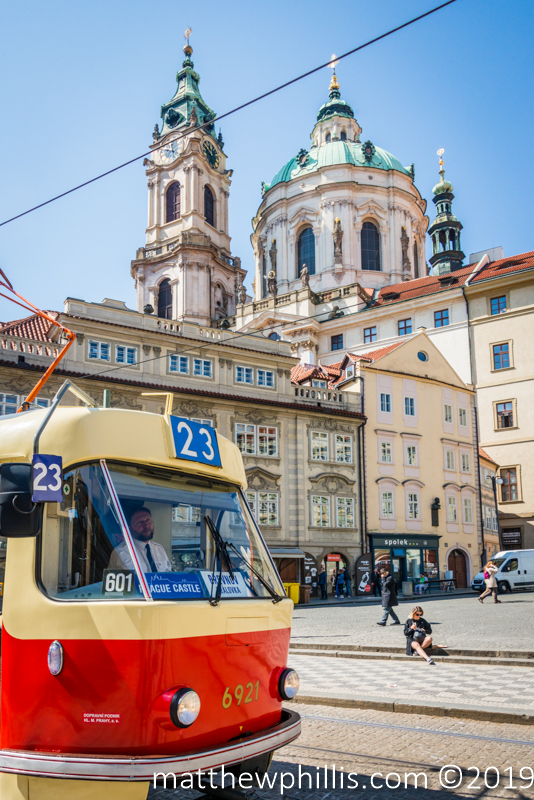
Trams are always fun!
Prague has many parks and gardens.
So much to see in this beautiful and historical city, and as always, so little time! There was a little time to walk around the city before getting the train to our next destination in the Czech Republic. We made the best use of time by checking out early, after a quick breakfast, walking down to the tram stop and getting a tram to the railway station to lock our bags up till we were ready to board our inter-city train. We bought our evening train tickets, for only 100Kr (€4), and headed out again. Bag-free, we strolled around to see the parts of the city we'd missed and to also relax a little from walking and enjoy the fantastic weather the city was experiencing. The tram itself is something you should do while here too, try and catch the really old ones for the real, bumpy experience. I've always found trams very exciting for some reason - is it because I never had them as a kid, trams only being in Melbourne (and very recently in Sydney, but they're not the same), or is it because it's just very European? Buy a ticket on board, ride the line, enjoy the sights and try not to look too much like a tourist - some people actually use trams every day to get to work and go home. Our last day in Prague before moving on was a bright, warm and sunny day, so we grabbed some food and had a picnic in one of the many gardens in the city. A bit of time chilling is always appreciated in the warm weather, and helps you relax, gather your thoughts for where you're going next, and very importantly as well, help you appreciated just exactly what you have here and now. We made the train in plenty of time, got our seats and enjoyed the 1 hour and 45 minute train journey to Hradec Kralove.
The Národní muzeum.
One of the many parks in the city.
Remember to also follow me on Instagram at:

UncleTravellingMatt. April 2019.

New Zealand Southland - Part 2

 Live the van life while you have it – no regrets The landscape on the South Island is simply stunning The view from Mount Cook road This wa...