Friday, 24 February 2017

Swiss holiday - Part 2 - Maienfeld and Mountains

Swiss dream house.
Helvitica on the 2 Franc coin.
Continuing on my Swiss holiday, but I need to mention a few thoughts on this lovely little country. First thing is, if you haven't noticed already is that I have changed the font to 'Helvetica,' in honour of my time here. If you thought that was just a font, you're sadly wrong! Helvetica is the female national personification of Switzerland, officially The Swiss Confederation - she is The Goddess Helvetia or Helvetica, and appears on the national currency. She is shown on the coins wearing flowing robes, holding a large spear and shield emblazoned with the Swiss cross, and her hair in a wreath. The name comes from the Gaulish tribe that lived in the area before the Roman conquest. I also have to add that no Swiss person I asked could tell me who she was... Enough of the history lesson - here are a few things that took me just days to realise about this country:

The mountains of Switzerland.
  1. Church bells are always ringing. Somewhere. If it's not a church, it's a cowbell.
  2. The inside of churches are deadly silent - Church is not a place for kids or talking. Ssh!
  3. The only noise you'll hear in a church is the organist playing. There is often one playing, but by a real person who is sitting up there playing for anybody and nobody.
  4. Everyone puts their names on their letterboxes and doorbells. Normally the only name you get on your doorbell in Australia is 'Friedland' (a brand of doorbell).
  5. Mountains are everywhere - you can play the game of closing your eyes, opening them at anytime and if you don't see a mountain, you win. Good luck!
  6. People work a lot here - maybe because it's so expensive. You walk around a town or city during the day and it's mainly people going to and from work - Spain on the other hand, people never seem to be working, just sitting around eating and drinking all day.
  7. The beds are the warmest and most comfortable in the World, including backpackers beds. The showers are also set to the perfect temperature and run at this temp within 2 seconds and stay that way. Pure bliss!
  8. There is always a clock nearby - you always know the time in Switzerland. They do love their timepieces here!
Mountains Gandalf, mountains!
I'm ready!
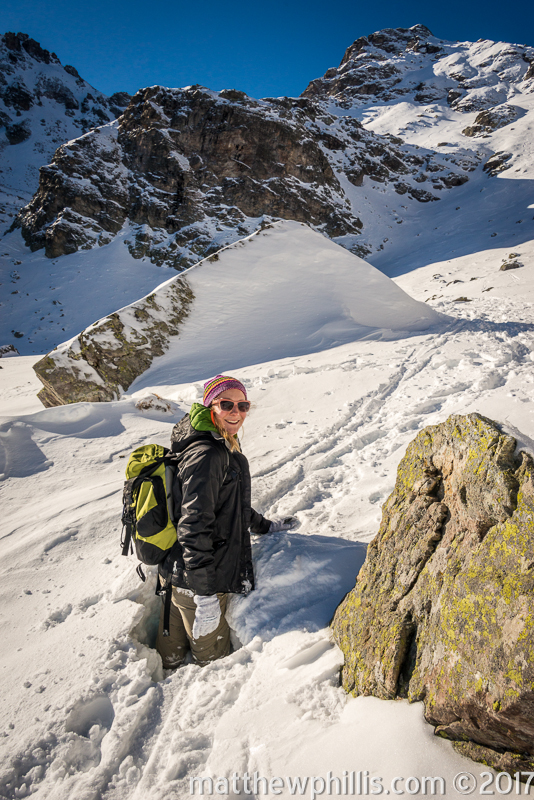
Ah! Watch your step!
It had only been 2 days so far in this small but amazingly beautiful country, and I was in love. I have always had a thing for small European countries (Andorra, Liechtenstein, Luxembourg) and this one was growing on me too. 2 days and I hadn't climbed a mountain yet either - I felt so bad about that, so much so that on day 3 we headed for the mountains to rectify it immediately! This country is full of mountains, look out the window and they are everywhere, so picking on to climb wasn't hard. We decided on the Pizol mountains, not far from where we were staying. We parked the car and walked up to the start of the lift that would take us to the top where we would hike around. Everyone I met in Switzerland was extremely open and friendly - people even mistook me for Swiss sometimes and spoke German to me - and the woman at the ticket office was no different. She felt terrible that she had to charge me so much to get to the top and tried her best to give me the best price, which still turned out to be steep - 42f (nearly $60). 3 lifts later and we were at the top, 2200m - the first lift was a comfortable one, enclosed with cushioned seats, but the next two were the normal chairlift variety, made for when you've got your skis on and are going from slope to slope - great for a view of the mountains and general area, but cold. Although not really enough snow to ski properly, there was a probably a little too much to hike properly! Sometimes we struggled a little, falling hip-deep in the snow, but we continued on to the top and were rewarded with a view of a frozen lake, so decided to enjoy the scenery and stop for a quick snack.

Chairlift to the top of Pizol.
Where do you want to go?
Our lunch time view.
With lunch over, we walked around for a bit, trying to get that 360 degree view of mountains. When it got too windy and cold, we started the descent, heading for the bar to chill in the sun before getting the lift back down. Apart from the high prices that haunts all ski slope bars and restaurants, the smell of the food and just the thought of a beer or mulled wine is nearly irresistible - there is nothing like sitting in the sun, all wrapped up against the cold but feeling warm after a hike or ski, enjoying a good meal, completely surrounded by a wonderful mountain view and also in good company. This is Switzerland. Something else about Switzerland is the friendliness of the people - on the chair lift down, there was a young family with 2 kids, one girl about 6 years old and a little 3 year old boy. The girl was sulking a little, complaining that she was cold (Alicia translated), so being a teacher, I decided to talk to the child - I told her I was cold too. She gave me a look of confusion and shock, then asked her parents what funny language I was speaking! I started talking to the father, whose English was very good, and the little girl (now smiling and happy) started talking to Alicia and both kids in the end were showing off how much English they knew and didn't want us to leave - in fact the little girl invited us back to her house, as she lived in town! Most kids would stay angry and not want to speak in a foreign language to complete strangers, but these kids were amazing! That made me smile and kept me smiling for the rest of the day.

Going down?
Looking up in awe.
St Christopher on the church in Zillis.
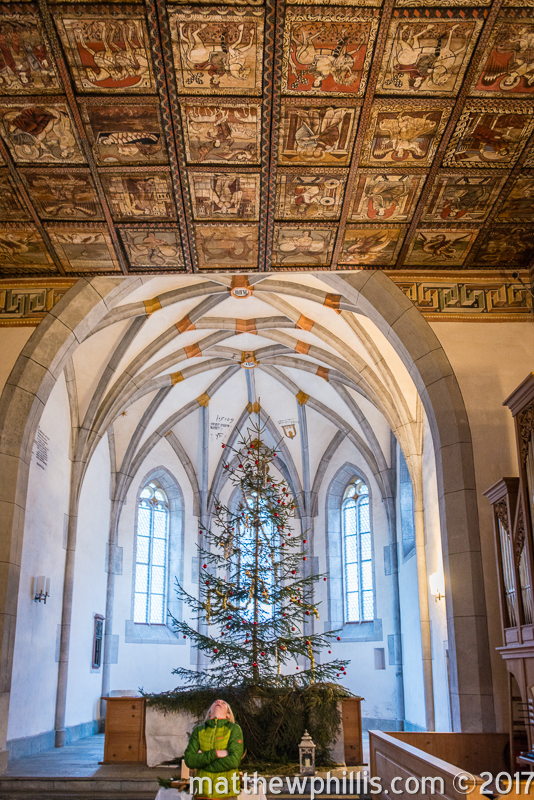
Before heading home for the day, there was a very special place to see. I'd never heard of this place before, but when it was described to me I knew I had to see it for myself. The sleepy village of Zillis, with a population of just over 400 (I saw nobody though), isn't anything special on it's own - yes, it's a pretty Swiss town with churches, but it has one very special church. Saint Martin's Church (or San. Martegn) is a Romanesque stone church, which from the outside looks like the rest, but as you get closer you see a huge, 10m high painted Saint Christopher. This is covered by a small roof to preserve the artwork, which if like what was inside, dates from the 12th Century. Inside is the true wonder - the whole ceiling is covered with wood panels; 153 square wooden panels of around 90 cm each placed in 17 rows of 9 panels to be exact! Each have a hand-painted scene on them, from mythical stories and beasts to biblical events as well as the life of Saint Martin of Tours, the patron saint of the church and village. The panels around the outside are all strange, mythical creatures, symbolising evil while the four in the the corners are angels who represent the 4 wind directions, warning the church goers of the Apocalypse and Last Judgement. 


The 153 wooden panels on the ceiling of St Martin's Church in Zillis.
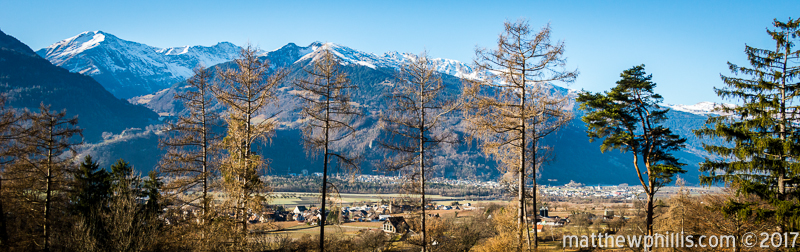
View from Heidihaus.
Maienfeld and Heidi's mountains.
Some else of note, which I only discovered afterwards, is that there a visual divide between the domain of evil and good with these paintings - a large Christian cross is formed by these patterns with the devil trying to tempt Christ with all the riches in the world at the crossing. The museum and the church were technically close, as we arrived at around 5pm, but being Switzerland, nothing was locked, so we went in for free. Even though nobody else was in the church, we were completely silent and in awe of what we were seeing. Incredibly preserved and nearly 900 years old, the panels have been restored but not painted over. It's hard to be staring up, bending your neck that far to see the ceiling, so mirrors are kindly provided. After a little while of just enjoying the art (via a mirror), we got back in the car and headed home - being winter and also surrounded by mountains, the sun here sets very early and it's completely dark by 6:30pm. So, early dinner, some wine and a movie and it was bedtime - ready for the next day! Today we were back in the car for a short drive to visit a place called Maienfeld in the Swiss canton of Graubünden.


A wonderful spot for just sitting and looking at the mountains.
The real Heidi!
Church in Maienfeld.
The town of Maienfeld, again, is nothing special itself - churches, stone houses, mountain backdrop, your run of the mill Swiss town, beautiful but not unique. The thing that makes this place special is the fact that it's famous for being the home of Heidi. The little girl of the Apls, Heidi is a novel written by Swiss author Johanna Spyri, and tells the story of a young orphan who was taken from the town and given into the care of her grandfather who lived up in the mountains. The story is so Swiss and everyone knows of it, but it was made famous by the Japanese-drawn cartoon from the 80s, and although the little girl had black hair in the original story, her hair was changed to blond for the TV - make her look more "Swiss" I guess. Again, the museum and general area was closed, being the wrong season, but we went anyway - following the signs that pointed the way to HeidiHaus, written in German, English, Italian and Japanese. Strange that you would get a sign in the middle of Europe in Japanese, instead of maybe French or Spanish, but Heidi is very famous in that part of the World and tourist come here just to see the village from the series.Because it was closed, there wasn't much to see apart from a few buildings, but the area was lovely - I wouldn't mind moving here myself!
Beautiful Switzerland - Hopp Schwiiz!

Thursday, 9 February 2017

Swiss Holiday - Part 1 - Chur and Arosa

My first view of Switzerland from the plane.
The
Time to visit Switzerland!
Switzerland is a country that I have never really explored properly. I know it's very close to Spain and Barcelona, only 2 hours by plane and also quite driveable on a road trip, and it's basically right in the middle of Europe too. I had in fact been to this little mountainous country twice before - once by accident. The first time I visited Switzerland was very short, as I was driving through France and missed a turn-off and ended up in Geneva. I had been visiting the lovely city of Annecy (still one of my most favourite places in France), and got back on the highway North and slipped across the border - I considered staying a bit but had other plans and so did a U-turn and got back into France. Sorry Switzerland! The second time was on purpose - it was a visit to the lakeside town of Lugano, just over the border from Italy. It was a day-trip, and although the town was very pretty, lake, swans and chocolate stores, it seemed more Italian than Swiss - it is a getaway town for the Milanese who want some nature rather than the industrial block that is the area around Milan. Both of those visits were nearly 10 years ago, so it was long overdue for another, and now had a local who promised me that I'd do it right this time around!


Chur - the place of the oldest settlement in Switzerland.
Churches everywhere.
A Swiss village in the moutains.
I landed early in the morning at Basel airport, excited but a still a little sleepy. Sometimes you don't realise in Europe how close you are to another country, but as I walked out of the airport there were two exits from the baggage claim - one for Switzerland and the other for France. Silly I know, but maybe it's an Australian thing, coming from a country/continent where your nearest neighbour is hours away on a plane. I was greeted and picked up by my good friend Alicia, whom I'd met hiking in Chile. I'd been nearly a year since then, and we'd stayed in touch (along with the two others from the group) and finally we were meeting up again! We drove from Basel to the city of Chur, close to where she lives, basically driving across the country in less than 2 hours! A car is a great way to see a country too, and this car trip was my first real look at Switzerland - mountains and more mountains, it was so beautiful! I did notice that the country is also quite industrial - along the highway there were numerous factories and power stations, not a complete eyesore on the landscape, but still a little unexpected. I guess there isn't much flat land here for building these kinds of things, and the Swiss do it as clean as possible, so before long you've forgotten all about the chimneys and go back to staring at the mountains soaring way above.

The church in Castiel and the beautiful hills of Luen.
Beautiful Chur.
The mountains behind Chur.
My friend's village is a short drive outside of Chur and is a very cute little place. Wooden houses with the winter fuel stockpiled up outside, a small church and even a square and one pub. Although not exciting, I never saw any of the 80 odd residents walking or even driving around, it was beautiful, peaceful and had some incredible views across the valley to the mountains reaching for the sky on the other side. Waking up in the morning I would be greeted by blue sky, snow topped mountains and a typical Swiss mountain village, all from the bedroom window! I could live here, I thought. I visited Chur the following day, and although it was cold, the sun was out and the sky was clear - problem is with these big mountains a lot of the town is out of the sun. Chur sits on the Rhine River within the Rhine Valley, as the river heads north along the border with Leichtenstein and Austria, eventually flowing into Lake Constance. It is also reputed to be the oldest settlement in Switzerland, with a settlement here dating back to 3900 BC and remains from the Bronze and Iron Ages have been found. The Romans conquered the area from the Helvetii people in 15 AD, and after The Empire fell, this region has been invaded many times, by the Ostrogoths, The Franks and even the Magyars (Hungarians), before becoming part of the Holy Roman Empire and eventually Switzerland in 1648 when independence came. It is a city full of history and beautifully typical Swiss architecture.


Shields on the main gatehouse of the Bishop's Palace, Chur.
The church in Luen.
The streets of Chur.
Although there isn't much to see as far as tourist attractions, there is actually plenty to see just by walking around and keeping your eyes open. The Episcopal Palace of the bishop of Chur was what I headed towards first, admiring the streets along the way of course. The Palace is more of a fortified city looking over the rest of the city, complete with high walls, a gatehouse and the Cathedral of Saint Mary of the Assumption, a 13th Century church. The crypt is much older than the main building, built around 770, and is said to contain the relics of St Lucius of Britain from the 2nd Century AD. A quiet Winter's day, nobody was around really, so we had the whole place to ourselves - it was beautiful, the buildings inside the walls were even more 'Swiss' than in the rest of the city, and the cathedral was quiet and lovely, but surprisingly small.


Beautiful painting inside the church in Luen.
Swiss fountains are amazing.
Every fountain is different.
Swiss cities are organised, clean and beautiful. Cars aren't double parked, people drive respectfully, and nobody seems to be doing anything even a tiny bit against the rules - nearly completely the opposite of many other European countries! I like order, being safe and feeling protected, but could I live in a place where you can't misstep without being noticed or even pulled up about it? It reminded me a little of Singapore - a colourful and interesting city, spotlessly clean and a place where nobody breaks the rules - you get looked at like a monster if you cross on the red! The other thing I noticed about Swiss cities, that really rang true when I visited Bern, was the fountains. Every fountain here is different, from the decorated taps and base of the fountain, to a statue standing proud over the whole thing. One I liked in Chur was a ram statue with huge horns. I'm not 100% sure, but I think that this ram is the symbol of the city or possibly the municipality of Arosa (which encompasses Chur). I also saw another of an armoured man, standing proud outside the church of St Martin, with his shield rested against his leg, a ram on it's emblem. Some small things like this are hard to find out exactly what it means - even locals may not know and it's too small or obscure to find on the internet. I like it - I will just make up my own stories! Chur was a lovely place, my first taste of city life in this country, and I think I was going the right way - from here it would be more traditions places, larger and even more beautiful cities, but I started at the oldest first!

Imagine waking up to this every morning? I did for nearly a week!


Wednesday, 25 January 2017

Christmas in Catalonia

Autumn sunset over Montserrat.
The town of Centelles and the mountains.
Centelles city centre.
Leading up to Winter and Christmas usually means cold weather and more to do at work before the holidays. While this was true for the most part, living where I do doesn't mean that the weather affects you too much - throughout Autumn is was sunny and quite warm, still hitting the high teens and even into the low 20s. Not bad really. So, to take advantage of this wonderful weather, more Ferratting was needed! So far I'd done 2 ferratas, one on Montserrat and the other on the Costa Brava, near Sant Feliu, and this one was back into the mountains - the Via Ferrada de les Baumes Corcades, near the lovely town of Centelles. We had a big group for this one, 9 people, so it was going to be a long day as the more climbers you have, the longer it takes, but also the more fun it can be too. It was the first time for a few people, but the great thing about this is that you can go at your own pace, take your time, enjoy the view and as long as you can make it through one part, you can always rest before the next section, or in most ferratas, you can leave at certain parts if you've had enough. We headed out early, arriving in the town at around 8am for breakfast and coffee, then we hit the start of the course. He got geared up while the mist was still hanging around, harnesses were strapped on, helmets, ropes and gloves put on and we were on our way.


The Via Ferrada de les Baumes Corcades.

A tough climb to the top.
The Via Ferrata.
Although technically not dangerous, this can still be quite scary. You're high up most of the time, sometimes standing on a small, steel step barely big enough for your toes, or even a big of rock - as long as you are attached to the safety cord at all time, a steel cable that runs the entire length of the course, you are just fine. This won't stop you from falling 3 or 4 metres and possibly hurting yourself (and maybe needing a change of pants), but you won't die which is the important thing. I've never fallen, but once you do a few you get more confident and this is when you can have problems - you get slightly over-confident, maybe lax in security, and you can slip up. This happened to me on my last Ferrata, and let me tell you, the feeling in your heart as you realise you nearly feel will guarantee you don't get too relaxed next time. One of the highlights of this trip in Centelles (as there were many) was the bridge walk - a good 5 minutes of wobbling and trying not to think about falling. The bridge consists of two cables to walk on, not wide enough to walk normally, you have to crab-walk the whole way, as well as two cables to hold onto and hook your harness to. The old saying of 'just don't look down' doesn't apply here - if you don't look at your feel, you will slip. Before the walk, we were all nervous, and talked about strategies to get us over the other side - we decided that a rhythm was needed, to minimise the wobbling by coordinating your legs with your arms, so we came up with a few songs to suit the situation - "Staying Alive" and "Walk The Line" were the favourites, good beat and quite fitting. Once at the top of the course, after the hardest part of the climb of straight ups and hanging over ledges, the view was amazing! There was also a very entrepreneurial gentleman selling cans of icy cold beer and sandwiches - the perfect end to a perfect day.


The 'hard yakka' climb to the top.

Puigsacalma.
Waiting patiently.
My birthday also fell into this period of cold weather leading up to Christmas. Normally I don't enjoy my birthday - it's another year down and although it's just a number, it does affect us. Most times I'm in a foreign country and I don't always have my friends with me because of this, so usually I find a mountain and go up it. This birthday was a little surprise, which really cheered me up. My friends surprised my by coming round to my workplace after work on Friday and we went out for dinner and a few (too many) drinks - but wait, there's more. (Not so) bright and (quite) early on Saturday morning, the Gin and Tonics still pumping around my system, we headed out towards to mountains - I was to get both things this weekend, a party with good friends and a mountain! It was cold and misty that day, a real spooky feeling. Autumn leaves littered the damp ground and there was a sprinkling of rain, but we headed up nonetheless, the forest cold and quiet. Nearing the top, the wind came rushing and cleared the cloud cover, leaving a truly beautiful sight - the Pyrenees in with a dusting of snow on them and us in the middle of the Pre-Pyrenees looking over the valleys of Catalonia. Once at the top, it was lunch time, a quick snack before doing a bit more walking. We weren't the only people enjoying the summit, there is rarely a mountain in this country that you would be alone on during the weekend, as people love climbing here, and there are also many dogs too, and the few that joined us for lunch for polite but very persistent about 'sharing.' After some more hiking, taking in the wonderful views, trying to stay warm, we headed down for a big Catalan lunch - sometimes the best days start of cloudy and cold, but then turn out to be the best.


The view from Puigsacalma.


The 3 Wise Men, or the 3 Kings, as they are called here.
Christmas Caganers.
Christmas was approaching, the street and store decorations had been up since early November, and people were rushing madly to get their Christmas gifts in. Here in Catalonia they have a big mix of local and imported customs related to Christmas and gift giving. Walking around all the markets they have at this time you'll see the usual for this time of year in Europe, mistletoe and wreaths as well as other traditional decorations, but there are also things to build and make "Pesebres." The closest word in English that I can think of for this is "Nativity Scene," but here it is so much more. In most towns and cities in Spain, people build, paint and decorate a special scene of Jesus' life - it may be Bethlahem and the manger, or the 3 Wise Men (called the 3 Kings in Spain). Some of these Pesebres take up as little as a shoe box, while others are absolutely enormous and take up several ping-pong tables worth! With intricate detail, these constructions are wonderful to see - most are made by children, which is a great tradition to uphold, but adults also enjoy it, most people do this in their homes too, and some are so detailed, with unique facial expressions on the models and little stories within the greater story being told. Competitions are held and crowds of people visit the various displays around the country - a must if you are here at this time!


The Christmas Log comes in many sizes, all cute and smiley.


Traditional Christmas scene.
Not so traditional scene.
Now, on the other side of the scale, from beautiful tradition to slightly strange and possible obscene, is the Caganer and Caga Tio. The Caganer, or 'shitter,' is a Catalan man, dressed up in his Berretina (traditional red hat) and smoking a pipe, that is doing his business somewhere in the Nativity Scene, usually hidden behind the manger. The poor baby Jesus and his parents have no idea what is actually going on and are probably more disappointed that they didn't book their accommodation before the big night. The 'Tio,' is the 'shitting log,' and the story is - you feed this little log, who has a Berretina and a cheeky  smile on his face, and on the 24th of December you sing a song to him (about how you've fed him and now you want him to give you presents in return), hit him and eventually, through the magic of Christmas, he will poo out gifts for the kids. OK, so you might say that this is wrong, poo and kids don't need any more focus as little kids are obsessed with the body as it is, but is worse to lie about an old, fat guy with a big white beard who rides a sleigh, pulled by 12 reindeer (one of which has a glowing nose), and manages to deliver presents to all the children in the World, fitting down chimneys along the way, in just one night? I actually like the tradition, and the children here love it. You start the whole thing by actually going out and find your cute little shitting Christmas log in the forest, the family pick it out just like a Christmas tree, you paint him, look after him, cover him with a blanket and sing to him, and in return he gives gifts - I think more believable than Santa, and more fun too!


The Monastery of Montserrat.

The Monastery and The Mountain.
The queue to see the Saint.
In the days before Christmas I decided to do one last trip before my 2 week holiday over the New Year period. Although I have been to Montserrat many times, it has something special about it and I never grow tired of seeing it again. This mountain, Montserrat, is the sacred mountain of Catalonia and according to legend, the first image of the Virgin of Montserrat shepherds found her children in the year 880. After seeing a light in the mountain, the children found the image of the Virgin inside a cave - the bishop of Manresa, the nearest city to the mountain, tried to move her but the statue was too heavy. The bishop interpreted it as the desire of the Virgin to remain in the place where it had been found and ordered the construction of the hermitage of Santa Maria, origin of the present monastery. Today you don't have to climb the mountain to see the monastery or the statue of Montserrat, you can drive or catch the train right to the doorstep. 


A Monastery cat.
Shhhhh!
The door to the Monastery.
The Monastery itself is beautiful and commands a wonderful view of the mountain and the valley below. There is always a queue to see the Virgin herself - I've done it once. You can see her from inside but to go closer you follow narrow stairs right up to see her sitting on her chair, holding the baby Jesus, and the first thing you notice is that she is black. I'm not sure why really, but I've heard stories of the statue being found on the mountainside after a big forest fire, completely intact but burnt. In 2001 renovators noticed that the black hands and face of La Moreneta (her nickname, meaning the Little Dark One) had changed colour over the centuries, and attributed the change to either to prolonged exposure to candle smoke or a chemical reaction caused by a varnish used as a paint sealant. She was probably carved in the 12th Century and her last paint job was back in the 18th Century - not bad for an old girl. She is now the Patron Saint of Catalonia, with replicas around the World, including in the church of Montserrate in the hills just behind Bogota in Colombia.


Some climbers on top of Cavall Bernat.


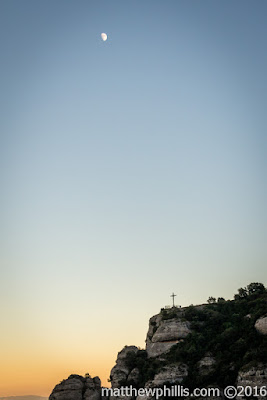
The moon rising over Montserrat.
Does that look like a mummy?
While the monastery is visited by pilgrims and tourists alike, my favourite part is hiking the mountain itself. There are 3 main peaks, Sant Jeroni (1,236m), which I climb up to on the Ferrata, Montgrós (1,120m) and Miranda de les Agulles (903m), but the mountain is not just these peaks, more like a serrated butter knife of ups and downs, peaks and valleys - in fact the name means 'serrated mountain.' The stone is pink conglomerate, and it seems to change colour sometimes, depending on the sun, from a cold grey colour to a lovely, warm orange with the setting sun. Each little peak has a name, and most actually look like something - one, called the Cavall Bernat, looks much like a man's face. Some of these rock formations you can climb up, and a lot of people do, but I have been told that there is also one priest, who is a qualified climber and will go up there to marry you upon request. Montserrat is a wonderful mountain, there are different tracks to follow at the top, every path giving you a different perspective of the strange rock formations, every hour of the day gives you a different colour.


The moon rising behind Montserrat.
Christmas time is a great time to be with friends and family, and I think in Europe it is a little more special due to the cold - I do miss a hot Christmas though. I was lucky enough to spend time with good friends here for the 24th and the 25th of December, sharing meals, good wine and of course exchanging gifts. The 26th would normally mean a sleep in followed by heated up left-overs and watching the cricket for the next 5 days, but this year would be (even more) special - I had a Boxing Day flight to Switzerland! Nothing says Christmas and Winter like 2 weeks in the beautiful Swiss Alps, right? Next stop, mountain paradise!


The Pyrenees - but next stop, the ALPS!


New Zealand Southland - Part 2

 Live the van life while you have it – no regrets The landscape on the South Island is simply stunning The view from Mount Cook road This wa...