Saturday, 26 August 2017

Ode to Catalonia


Mountains revisited.


The ruins at El Brull.
Not much shade at the top.
As mentioned in my last blog entry, I’m moving to Africa – in fact, I’m actually sitting and writing this in my new home in South Africa, a place called The Valley of 1000 Hills. I’ve moved to a rural Zulu community in the KwaZulu-Natal province of South Africa, roughly an hour from Durban. I’m working with a local community centre who provide after school care for the local children, as well as cultural events for visitors, tourism activities and also training for the youth in the community to become tour guide and trainers. But more on that in the next entry – I would like to talk about my last few weeks in Catalonia, which has been my home for 5 years out of the last 13, longer than I’ve lived in my own country in that period. It’s a strange thing sometimes when I think about it, how many years I’ve spent overseas. People ask me why, why don’t you live in Australia where you get good money and have a great lifestyle, why do you live here where the money is bad? My answer is always ‘Why not?’ There is far more to life than a job and money. Since leaving Australia the first time, way back in 2004 to the UK, to work in pubs and travel around their little island, I guess I have changed a lot. Everyone talks about travel as being the best educator, and sometimes that is true – it opens you up to new languages and cultures, new people that you would never have met before and new experiences that you would never have got before. Whether you let these things change you, or let yourself go with the changes, it’s up to you – just because you travel doesn’t mean you become this educated, mature and sophisticated person, just like wisdom does not come with age. My accent has probably changed too – learning a new language can do that, so does the fact that I teach English and speak to non-Natives, but it’s still funny how you revert back when you meet someone from your neck of the woods.

The start of the hike to Matagalls.

Stunning weather for a hike!
A large and very beautiful butterfly.
Sant Segimon.
To ‘celebrate’ my life in Catalonia, I decided to climb a mountain or two – very fitting I think. I truly got into the hiking scene over here, with places like Montseny and Montserrat so close, continuing in South America with The Torres del Paine in Chile and Fitz Roy in Argentina, and since then it has become more and more a part of my life. If I don’t get out and hike or climb every few weeks, I start to go mad. Catalonia has some wonderful mountains, inside the country as well as the Pyrenees that run along the border with France. Back in February, fresh from hiking in Switzerland with snow, I hiked to the top of Matagalls in the Montseny National Park. At this time, the country had had a bit of cold weather and snow, just the right amount to walk in without snowshoes. It was beautiful – a 2 hour hike up in fluffy white powder, deep blue skies with a wisp of cloud here and there, a view of the Pyrenees on one side and a view of the Mediterranean on the other. I had such a great time that I thought that I’d come back and do it again in Summer. On a sunny July day, myself and 4 good friends headed out to climb the mountain again – but before that, a good, hearty breakfast was needed! We sat down at the only restaurant in El Brull, a tiny village just before the start of the hike at Collformic. Tostades (thick toasted bread) with pernil and cheese, a good coffee and we were ready – and we also knew where the post-climb beers would be, which is very important! Although not a very tough hike, it’s still decent, and the weather was quite warm. It’s impossible to get lost, as there is a clear path and markings all the way, but there is very little cover, so the heat would be the problem here – but water had been packed, and also a snack for the top, which turned out to be peanut butter sandwiches!

We weren't the only ones enjoying the fresh air.
The little stone 'hermita.'

The crew.
The monument at the top.
Along the way, I looked up at the top, where the large cross sits, and there was a huge crowd. I still have no real idea what it was, but by the time we reached the peak, there were pack horses loaded up with food and other things. I think there was some sort of service here, as it was a Sunday, but I can’t be sure. Luckily the crowd had more of less dispersed enough for us to get in our selfies and photos at the top – to celebrate, commemorate and remember the wonderful feeling of making it all the way to the top, all 1692 metres in this case, whether you’ve done it before or not. A quick drink and bite to eat was all we really had time for – some dark storm clouds were moving in and I was slightly worried, even more so because we’d decided to return a different, and slightly longer, way back to the car. We headed down the trail, walking towards Sant Segimon, a small ‘hermita’ right on the edge of the mountain. Built of stone, this little hermitage has seen better days, it’s roof sagging and on the verge of collapse, and the door completely missing. But, it’s still standing, despite being completely open to the wind, rain and harsh Spanish sun. If there were a storm to come in, this is where I’d be waiting it out. We then went down a steep path of loose rocks and sharp angles, but after the hard part was done, it was an easy road all the way back to the car. Normally I don’t like gravel or even paved roads to hike on, this was a pleasant way to finish of the last few kilometres, giving my tired legs a chance to just walk, stretch out a little, and ease done before lunchtime, when I’d be sitting down for a while and my lets would stiffen up. Lunch was the second highlight of the day – traditional Catalan food, topped off with beer, wine and some good friends. The beer at the end of a hike is always the best!

Matagalls in Summer - hot and no real shade, but beautiful.

The mystical Pedraforca.
How are we getting u there?
The road to 'The Forked Rock.'
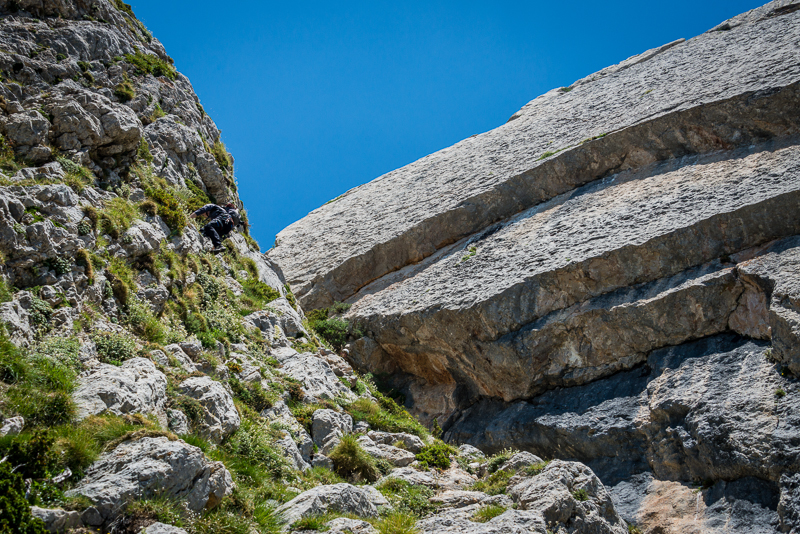
I had one more mountain on my list of things to do before I left. This one has been on that list for some time – a favourite mountain of mine, and one that I’d visited before, but only hiked to the refuge. Pedraforca, in the mountainous area around Berga, is something special indeed. It’s name comes from the shape – a towering two-peaked stone fork. Following the curving road to get there, I love seeing this beautiful form of nature pop out amongst the trees – so big but you only see it at the last minute! A quick coffee is a ritual I have with my friends before we hike or climb, so the 3 of us had ours, made sure of our plans, then headed off. I knew this would be a long, hard day, but I had no idea what I was in for to be honest! The plan was to hike around the smaller peak, angling up and climbing through a hole on the side of the mountain, then climbing (without ropes) up a steep and gravely ‘path,’ then finally reaching the shorter of the two peaks, the ‘Pollego Inferior,’ at 2444m (compared to 2506m for the ‘Pollego Superior’). It started off well and a fairly standard hike, but things go a little hairy when we hit the gravel paths. It’s hard climbing over rocks of various sizes, the big ones can move and roll, and the smaller gravel is loose under you boot and can make you slid back down the path, bringing rocks and debris with you. After a good hour of this, we made it to the hole – we strapped on our climbing harnesses as this part required some safety ropes. Sometimes when you’re hiking, all you look at is the path right in front of you, or your final destination – I like looking back and seeing what I’ve accomplished so far! Looking up can also make you lose heart sometimes, thinking that it’s too hard and that you won’t make it. This is what the next part looked to me.

Straight up!

The hard climb to the top.

The sheer walls of Pedraforca.
Setting up the ropes to abseil down.
The next part of the climb, and yes, it had turned from a hike to a climb, was tough and also a little scary. We couldn’t use ropes, as there was nowhere to tie on to, nor could we tie on to each other – if one person fell, he would pull the other 2 with him. I didn’t know this part existed or how hard it would be. I’m fairly fit, tough and stronger than I look (mentally and physically) in my opinion, and this climb put all that to the test. The climb was steep, more than 45 degrees and I’m sure nearly 90 in some parts, the rocks were either too lose to hang onto, too flat or worn to get a proper grip and the grass was also sharp – there was no winning here! I made a mistake about half way up and got a little stuck – I couldn’t go up, nor left or right. I had a moment of panic, no helped by looking down, and thoughts ran through my mind like “I’m not going to make it!” to “I just need to hang on till my friends call the helicopter for me” and then “I think I’m going to fall,” and if you fall you know what happens. It felt like a long time, my mind running away from me, stupid thoughts, my legs had started to shake, but I managed to pull myself together – with the help my good buddy who came back down at his own risk and helped guide me down, then to the right path. A truly hairy moment that I could’ve done without. After this was accomplished, it was a shorter, but still tough, climb to the top. But the top! My sore arms and legs immediately felt better, my mind clear, my heart pumpin not out of exhaustion but out of the thrill of being 2444m high, having made the tough and long climb to get here. I’m not a true mountain climber – those guys and girls are absolute beasts, and true athletes – but I do feel the ‘allure’ of the mountain, the need to climb, and the addictive feeling to it. After 6 and a half hours, we’d made it! After a 30 minute ‘lunch’ break, we abseiled 3 30m ropes down to where the gap in the forks lay, then the walk back down to the bottom would begin. This took at more than 2 hours – again, loose rocks, gravel, steep angles. This part of the hike I dubbed “The Knee Breaker,” and it was true – by the time we reached the car and had our ‘hallelujah’ moment (when you’re so tired and you just make it to the car), my legs were so sore, my knees shaking, and I was very much in need of a beer or three!

The view from the top.

Winter is coming... or is it Summer?

My two companions on the climb, Manel and Joan.
The taller of the peaks, but the easier one to reach.
So one again my time had come to an end, the time to pack up my life and move on again was here. After living in South America for a year, packing up my life in Sydney and moving there with a one way ticket, I swore to myself that I wouldn’t do it again. Chile was a tough time for me – it was hard to make friends, hard to learn their funny way of speaking Spanish, and the weather where I was living was miserable. After returning to Barcelona, I thought that I would be here, as much ‘for good’ as is possible with me. Things change, people change and opportunities arise. I visited South Africa way back in 2015 for the wedding of my good friend Donovan to his long-time girlfriend Bonnie. I had a great two weeks – catching up with Don, who I’d met in Scotland in 2005, meeting the truly awesome Bonnie, along with all their friends, and of course, the wedding was amazing! I visited a Lion Park and also went on a week-long safari, managing to see (and photograph) the Big Five in one day. The excitement was there to return, but of course I would be leaving behind some really amazing people here, who have become my second family. I will miss many things about this country, the Festa Major, the food and traditions, but most of all the people. Thank you to everyone who has enriched my life – anywhere I am, you are welcome, no questions asked, and the next Gin and Tonic is on me. It’s never goodbye for good friends, only ‘see you later.’

Incredible view from the top.


Goodbye mountains of Catalonia... or should I say, 'see you later.'

Monday, 31 July 2017

Madrid Getaway

Madrid loves flags!
Statues aplenty in Madrid.
The beautiful National Library.
My weekend in France was just what the doctor ordered. I got away from the Sant Joan fireworks, with all it's festivities and noise, and retreating into the Southern Pyrenees for 3 days of rest, relaxation, and a little bit of hiking and city sightseeing. After this trip, I finished up my job here, and was now completely free - unemployed and free as a bird. Just the way I like it. I decided to make a trip to Madrid for a few days, for a few reasons. A lot of people in the city would have left already, flocking to the coast for the sea and cooler temperatures, so now was a good time. I'd been to Madrid a few times previously, but as I like the city, I thought that one good turn deserved another. I also had a bit of business to do there with the Embassy, so put all 3 together and you've got yourself a trip! As I don't have a car, nor could I afford the AVE high speed train, I had to pleb it on a 7 hours bus overnight. After travelling through South America, pretty much from top to bottom (but in the reverse order) on a buses, the longest journey being 38 hours, this would be no worries. My bus left at 1am, so I had a bit of time to kill beforehand, so I tried to find a bar to have a quiet beer and a bit of dinner before my trip. The area around Barcelona Nord bus terminal is not very pleasant, dirty, noisy bars, full of people waiting for buses or for family getting off the bus, taxi ranks and tourists - your typical bus terminal 'bari.' I did get a beer and some food, but not peace, as fireworks were being let off, crackers that sounded like a bomb going off, people on the streets... Barcelona is never quiet. This made me miss my little routine that I had in Concepcion, the city where I lived in Chile, before bording a bus somewhere - I'd go to the terminal a few hours before my bus (never booked ahead, just turned up and bought an overnight bus), go upstairs and have a $1.50 hotdog (Chilean Completo) and a few beers. a relaxing way to start a bus journey - the beer also helps you sleep.


The Historical Central Post Office - also known as the 'Palacio de Comunicaciones.'


Bike Mad! The public cycling system, nowadays so common throughout Europe.
Colourful Colonial buildings in Plaza Mayor.
The cathedral of Santa Maria.
Waking up in Madrid, not quite fresh but ready to go, was exciting. It'd been years since my last time here and I was ready to see the city. As the capital city of Spain, seat of government, and residence of the Spanish monarch, Madrid is also the political, economic and cultural centre of the country - it is also the 3rd largest city (as far as population goes) in the EU, after London and Berlin. The funny thing about population statistics that I don't understand is the Metro and Municipality (sometimes also called Urban) areas - they are always 2 very different figures and it's hard to say how many people live in a city. Going with the larger figure, Madrid has 6.5 million residents compared to Barcelona's 4.7 million. Although there have been people living here since Prehistoric times, the Romans were here, so too were the Vandals and Visigoths, but the city itself actually started off as a fortress built on the border of Al-Andalus (now Andalusia) and Castilla y Leon by the Mors to protect Toledo from the Christians. The Moors and the Spanish fought, land going back and forth, but finally Toledo surrendered to Alfonso VI in 1085 and Madrid was taken by the Christians, pushing the Muslims and Jews to the outskirts of the city. Over the next few centuries, Madrid grew rapidly, by 1202 becoming a city, and in 1561 the King, Phillip II of Spain, moved his court here and thus making it the capital of Spain. The Spanish Constitution of 1931 was the first legislated on the state capital, setting it explicitly in Madrid. During The Civil War, the capital was heavily affected was the first city to be bombed by aeroplanes in 1936. Since then, the city has recovered and grown and become a city worthy of the Capital title that it holds - bold stone and marble buildings stand tall, flags wave, statues and monuments are everywhere.


Philip III in Plaza Mayor - the central square of the city.


"All Roads Start From Madrid."

Statue of the Bear and the Strawberry Tree.
Love locks in Plaza Mayor.
I don't generally like flags everywhere in a city, a few are ok and expected on certain buildings, but Madrid would be in the running for the city with the most flags, Paris being a city that would have a very good chance of winning too. How many flags does a city need? On my walk to the hostel in the centre, I walked past one of the biggest flags I've ever seen - possibly only rivalled by that in Santiago de Chile - in the Plaza de Colon. The square was renamed in 1893 to commemorate the explorer Christopher Colombus, or Cristóbal Colón in Spanish. Walking around the city I noticed that it is far dryer than Barcelona, and upon returning I noticed this even more and realised how humid it can get here. I found a cheap hostel, which was just a converted apartment building, but it was small and very central, so it suited me just fine. I dumped my things and headed out before it got too hot. The Puerta del Sol (Sun Gate) is the centre of Madrid, and actually the centre of Spain. There is a plaque here, stating that this where all the roads in Spain start from - and although it's cool, as Madrid is the capital and also the dead centre of the country, who do they think they are with this "all roads start here" business? A little too like the saying "All Roads Lead To Rome." Anyway, I lined up for the photo of my feet there on the plate, like a good tourist, took a few of other people for them, then moved on. Another thing in this Plaza is the statue of a bear trying to climb a tree. Well, I'm not sure if it's climbing it, trying to get a squirrel that's hiding up there, or peeing on the trunk, but this is the symbol of Madrid and I shouldn't say too many bad things about it. The naming of Madrid is not exactly known, it was called 'Matrice' by the Romans, later changed to 'Mayrit' after the Islamic invasion, and now 'Madrid,' which is still pronounced 'Matrit' by the locals (called Madrileños). Another speculation is the old name for the city, dating back to the 9th Century AD was "Magerit," which translates to 'bear.'
Plaza Mayor and the statue of Philip III of Spain, with The Casa de la Panadería (Bakery House) in the background.

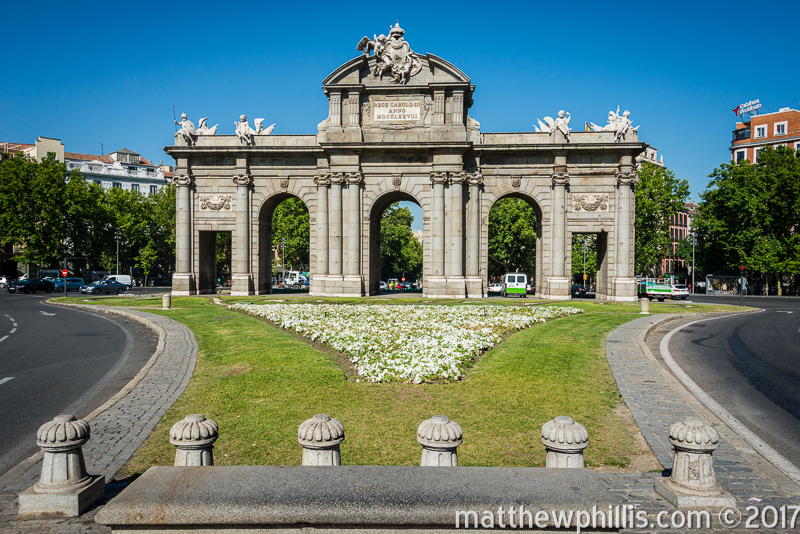
The Puerta de Alcalá.

Dressing up in Plaza Mayor.
Plaza Mayor and it's painted buildings
Madrid is full of huge buildings, statues and things that a capital city should have. One of these structures is the Puerta de Alcalá, a Neoclassical, 5-arched triumphal gateway which sits on the round-a-bout in Independence Square. It is regarded as the first modern post-Roman triumphal arch built in Europe - started in 1774 and designed to make a huge gate for the city walls, it was finished in 1778, making it even older than the Arc de Triomphe in Paris and the Brandenburg Gate in Berlin. Plaza Mayor is in the heart of the city, surrounded by beautiful, colourful buildings, the square is the place for people to come and eat and drink, and to people watch of course. Although not as many as tourist as Barcelona, this city still has it's fair share, and many of them are drawn to this point for the restaurants and bars, but also the lovely buildings that make up the Plaza - three-story residential buildings with over 200 balconies facing the Plaza. There are nine ways to get into this rectangular 'square,' and the Casa de la Panadería (Bakery House), which serves as a kind of City Hall and Tourist Office, stands out, a large emblem of stone stands on the fascade and is topped by a gold crown. Although there isn't much shade, and it was very hot, I sat and watched the people come and go, mainly stopping for selfies, and even some police horses walking around the square. In the centre of these buildings, right in the middle of the plaza, stands the statue of Philip III riding his horse.


The courtyard in the Royal Palace.


The Royal Palace.

One of the many places to get beer and tapas.
Looking down Gran Via.
The Royal Palace of Madrid is also worth seeing while you're here - although I've never been inside as the queues are nearly as long as the palace is big. Although it's the official residence of the Royal Family in Madrid, they choose to live in the nearby Palace of Zarzuela on the outskirts of the city. The palace is located on the site of a 9th-century Alcázar (Spanish for a "Muslim-era fortress"), near the town of Magerit, constructed as an outpost by Muhammad I of Córdoba, but has been extensively updated and renovated, a lot of work being done in the 16th and 17th Centuries. On Christmas Eve in 1734, a fire tore through the building and burnt it to the ground - sadly many paintings were lost during the blaze, but thankfully some were saved by people throwing them out the windows. The fire lasted 4 days and basically only went out when there was nothing left of the palace. Work on the new building, the one we can see today, started in 1738 but has been enlarged and renovated since. The Palace has 135,000 square metres of floor space and an incredbile 3, 418 room, making it the largest palace in Europe, and houses many great works of art from artists such as Caravaggio, Fracisco de Goya and Velázquez. As beautiful as the building is, it's very white and quite bright in the harsh Spanish sun - you definitely need sunglasses to look at the thing, and a chair (maybe an umbrella for the sun) to sit on if you decide to line up for the tour. It looks a little like Buckingham Palace in London, but slightly fancier and with more statues, and two long arms reaching down either side. I guess this things can all start to look alike after a while.


Plaza de España with the statue of the famous writer Cervantes and his well-known characters.


The original 'Dynamic Duo,' Don Quixote de la Mancha and  Sancho Panza.

Apartment buildings in the city.
Not a bad place to live really.
I could talk all day about the grand old buildings here, but Madrid is truly know as a great city for eating and drinking in - yes, that's right, Tapas! On my second day in the hostel, two Aussie guys checked in, they landed in Madrid after a 30 hours trip from Australia, and although were a little jet-lagged, were excited when I told them about the 'beer and food' situation here in Spain. We hit the streets to find cheap booze, accompanied by cheaper (as in free) fried food. There was a little place call "El Bar de los Tres," the Bar of the Three, that I found the previous day by accident, liked it, so I came back. For €1.30 you get a glass of beer and a small plate of food - maybe fried potatoes or empanadas, you choose from their windowed selection on the bar. Most of the time it's not gourmet food, it is what it is - fried and free. Some places are better than others, for example I found a place that for the same price I got a beer and pickled whitebait with a few olives as a tapa - absolutely so awesome that I had to stay for another beer. One place you need to do this eating and drinking is in the Museu de Jamon - the Ham Museum. Although it's not actually a museum at all from what I could see, but you get cheap beer and a good selection of tapas for less than €1 each - in fact a beer was €0.70 and a tapa (small ham or cheese sandwiches) were €0.80. Doing things this way you can go home to bed, having had a decent amount of beer and free (or very cheap) snacks, enough to make you feel tipsy but with a full belly, for less than €10. Where else can you do this in Europe I ask you! I did this for most of the evening, coming back to the hostel feeling very satisfied, only to be 'sucked in' to more drinking and eating with the hostel owner late into the night. The next day I said goodbye the Australian brothers, wishing them luck in the San Fermin running of the bulls festival in which they were taking part - I saw on the news a few days later that about a dozen people were injured, and hoped it wasn't them.


Madrid is a beautiful city.

Buen Retiro Park.

Parc Retiro in the centre of the city.
The famous "Schweppes" building on Gran Via.
My last day in Madrid before heading back home was spent walking around and seeing a few things that I'd missed. One of these was Plaza de España, which is where the statue of Miguel de Cervantes is located. He sits in front of a reflection pond, backed by a huge column, which is topped by the figures of people reading books next to a globe. In front of the great author are his characters - Don Quixote de la Mancha and  Sancho Panza. Although I haven't read the book (yet) it is considered one of the greatest literary works in the World. I found it amusing how many people were getting their pictures taken in front of these bronze figures, whose legs and feet were noticeably shiner from everyone touching them. On my way back to the bus terminal I stopped off in Buen Retiro Park, a huge park with a man-made lake in the middle. Last time I walked through this park I was offered all sorts of drugs, but not this time - and somehow I was a little disappointed. I remember my time in South America travelling with my American friend from Seattle, how when we walked down the streets in certain cities in Colombia or Peru, I would get drugs offered to me and not her - she always said that she wouldn't have bought them, but it's nice to be offered. I told her that it was a compliment - she was clearly too sensible and wholesome looking to buy drugs off the street. I'm glad it appears to have been cleaned up a little, as no city needs a place for dirty drug dealers pushing their shit on tourists.


Rowing in Parc Retiro.


The Madrid Metro.

I made it back to the terminal with plenty of time for my bus, and so concluded my business in Madrid. To be honest it was not just a visit, but a kind of 'business trip' - I came here to apply for a Volunteer Visa for South Africa. My visa has just been approved and my passport returned, and so in less than a week I'll be working in South Africa. I'll be working with an NGO outside of Durban, in an area called The Valley of 1000 Hills, in a rural Zulu community, working with kids and young people, teaching English and helping out with sports and other activities. I was there back in 2015 for a wedding of a long-time friend, and for the past 6 months I have been working to get papers together and everything I need to make the move there. After a long time of working and waiting, it has all come together, and so my next leg of my journey begins. Although I have little money myself, there are people with far less, so this time it's not for me, not a trip, but working with people and helping, not with money but time and skills - this time for Africa!


Goodbye Spain (again) and hello South Africa (again).

New Zealand Southland - Part 2

 Live the van life while you have it – no regrets The landscape on the South Island is simply stunning The view from Mount Cook road This wa...