Monday, 6 June 2016

The Galapagos Islands - Part 2

I hate boat trips!
Getting in line at the markets.
Baby tortoises at the breeding centre.
Having survived the 2 hour, sweaty and sea-sick inducing boat ride to Cristobal, I next went on the hunt for a room. I've mentioned before that this place isn't cheap, and I will say it again. Anywhere else in Ecuador I can get a room for less than $10 - here the cheapest I found was $15 with a fan (that didn't do anything in the heat apart from make a noise) and $20 with air-con. I know they do it here because they can - what other choice have you got? The cost is not only for rooms, but food and drinks as well as transport - there are no buses to get around on, so you either walk it (and die) or catch a cab for $20. I tired to save as much money as I could but also see what I wanted to and make my trip really worthwhile. I checked in to the hotel, which at least had WiFi to keep my busy while I sweated away at night unable to sleep, and went out for a walk. San Cristobal is smaller than the other two main islands,  but there is plenty to see. A quick walk from the town are many beaches, and the they are lovely - nearly Caribean in appearance. Palm trees, golden-white sand, light blue water... but with seals and iguanas everywhere! The seals usually lay around during the day, sunbathing like the tourists, and get a little friskier in the mornings and evenings - you can see them playing with anything they find in the water, or rolling around in the shallows, letting the waves crash all over them. There are a few good snorkelling spots here too, but I used the 2 days I had here to chill out and relax at the beaches.

This is my bridge!
A baby seal taking a siesta.
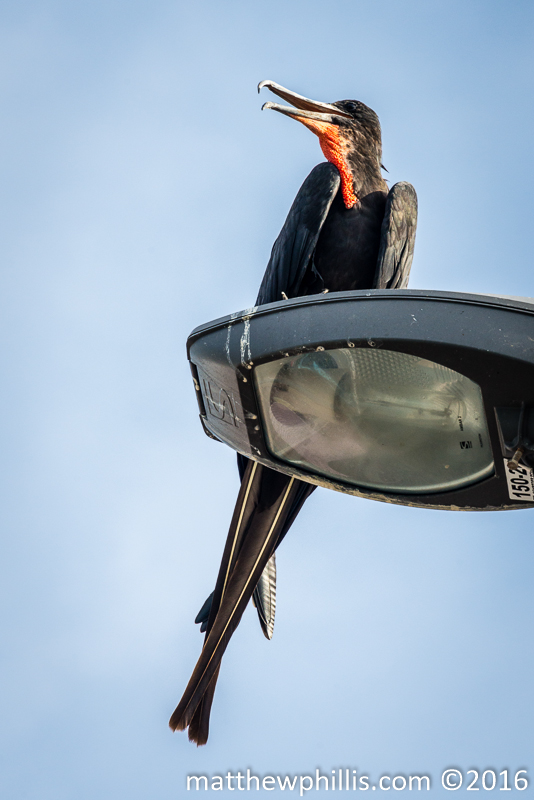
The Frigates have picked a good spot!
I hired a bike and snorkel to visit the beaches - one spot for swimming and snorkelling is Playa Punta Carola, and a little further around there is a bay where seals and sometimes even turtles swim. I didn't see any turtles, but swam close by some seals - keeping my distance as I didn't want them getting angry with me. I just enjoyed watching them play and swim, little fur-torpedoes in the waves. Right up on the cliff there is a great lookout spot at the nesting frigates. These large birds, reaching 114cms in length and with a wingspan of 2m, cruise around for most of the day, hunting for food. It was hard seeing one up close, as they generally soar quite hight, and I never really got a good look of that postcard photo of them with their large red throats out, usually only during breeding season - the view I got was their 'W' form high up in the sky. The other beaches were also nice, again filled with animals, and this island had a much more relaxed feeling to it. I got the chance to catch up with Laurel, as she was on a week-long boat trip of the islands - something I wish I'd done but couldn't afford. We had a drink together, swapped some stories, complained about the weather (kind of), and then she had to get back on the boat. Being on a boat you can miss some things, I got to walk around a lot more and stick my timetable of 'do it when you want,' where as on the boat you have to conform and go with a big group. On the other hand, you see far more than you can by just being on land and get to swim and snorkel straight off the boat. If I had my time over (and more money) I would choose the boat option.

Iguana on the beach.
It's hard work being a tortoise!
A lava cave on Santa Cruz.
I got back on a boat to visit my 3rd island, Isla Isabella - 2 hours back to the main island, stay the night there (as you can't go all the way in one day), and jump on an early 7am boat and do it again - good news was that I only had 1 more boat ride to go! Isabella is much bigger than the other islands, in fact it's the largest. All the islands have volcanoes on them, but this one has 6, one of which you can see nearly all the time you're on the island - clouds gather around it, and I think it is still active too. There are some great beaches here too, long strips of white sand with very few people on them - but being Australian, I have been spoilt for beaches (even Sydney city beaches are great!), I didn't find these ones to be so wonderful that I had to stay on them all day. I walked a lot here - my previous experience with a rented bike was no easier than walking, and in fact more sweaty and more work! The tortoise breeding centre was here, and I got to see hundreds of tortoises from tiny baby ones to huge ones that would win blue ribbon prizes. Although there wasn't information, it was interesting to see so many in one place. Just up the road, my hopes of seeing one in the wild came to fruition! There was a decent-sized tortoise sitting in the middle of the road, scared into a statue-like state as 2 Austrian girls took pictures of her. It doesn't take much to scare one of these creatures, and it also makes it easier to snap photos of them! Dinner on this island was also cheaper and better value than Santa Cruz and Cristobal - less tourists and fewer restaurants make more competition. I was able to get a nice menu for $6, but beer was still nearly $4 a pop!

Hey I'm walking here!
Caution - Tortoises on road.
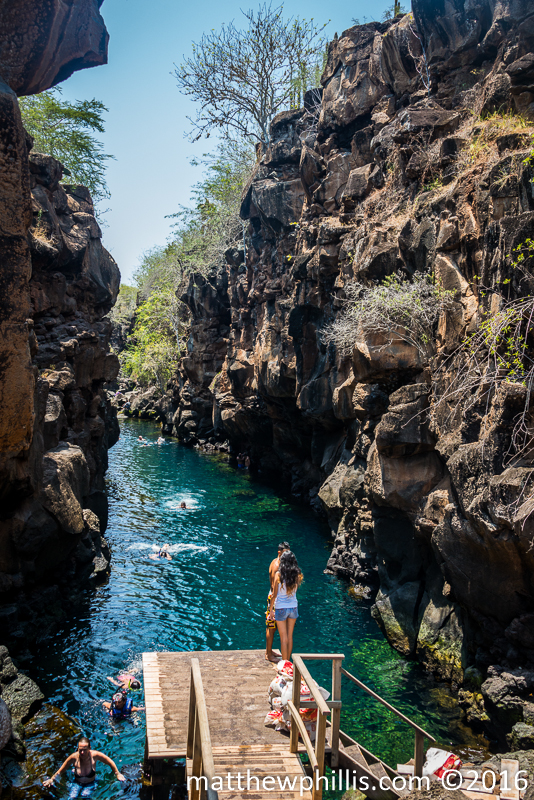
Las Grueles.
For my last few days I headed back to Santa Cruz, the first island and the one where the airport is. Running our of US dollars (story of my life) I was kind of forced to do things that didn't cost any money. I found a lava cave a short 20 minute walk from the town, and was able to climb right in! As lava flows downhill, the top cools and forms an insulating crust that keeps the interior lava hot and running. When the flow begins to subside, it drains out one end, leaving the harder crust around the outside, making it look like a huge worm has tunneled through the rock - the sides are smooth with small grooves and you can see where the lava actually flowed. 

Boobies!
A Galapagos tortoise chilling out.
Les Grueles - a great swimming spot!
It was also cool in here and free of tourists! I was told of some places to go by a friend who had been here a few months ago, and one of those places was Las Grueles. A short boat trip from the docks to a small peninsula and a 30 minute walk had me in a deep ravine filled with the bluest water you have ever seen! The water is a mix of fresh (or 'sweet' if directly translated from Spanish) and salty water, providing a nursery for fish and animals who then go out to the sea. The place was packed as you could imagine, but I still really enjoyed it - there was a rough wooden pier to jump off, diving into the water. I tried touching the bottom, and only just managed by doing a pin-drop. You could nearly see right down to the bottom as well, and lots of people had snorkels and masks as there were some very big fish here. I also got to see some Boobies, which I was very excited about! The Blue Footed Booby is a bird seen only in a few places around the World, and here is one of these places - the bird's feet are bright blue and the male kind of do a 'goose step' to strut their stuff and show off their blueness - the bluer the better for the girls. They are very strange looking birds, with intense eyes (and the obvious feet), and also have a different way of getting food. I saw them when I first got to the island but didn't realise it - they dive-bomb the water, plucking out their prey and then flying off with it. Even stranger is the chicks - they will kill their siblings to get the food and full attention from their parents, both of which will stand by at allow this to happen. Sadly the population of the Booby is declining - it is thought that the food source is the reason. Sardines make up most of their diets, and the bird won't breed unless they have an adequate food source. Killing your brother or sister won't bring more sardines to the sea.

One of the great beaches on the Galapagos.
Always watching (for food).
Wildlife is just so abundant here!
It was time to leave however, my 8 days were up, and it airport time. Easier said than done, as I got up to grab a bus but discovered that the only bus service rang at 8am. My plane was for 3pm - anyone else keen on waiting 7 hours at one of the smallest airports in the World? Well I assumed that there would be more than one, but was mistaken, a mistake that cost me $18 to get a cab. I was a little over these islands, and the price of everything was one reason. The previous day I walked around town looking for some last minute gifts (an "I Love Boobies" t-shirt for myself of course...) and couldn't get a shirt for less than $18, postcards cost nearly $1 each and I didn't even look at anything else. There is also what I call an "island vibe" here - what I mean by this is that there are mostly couples, rooms for 2 and menus for 2, and everyone's holding hand or spending time at the beach together. If you are alone in a place like this, like the Maldives or French Caledonia too I'm sure, you can feel a bit lonely. It was a great time though, and looking back now at the photos and remembering, it was probably one of the most amazing places I've ever been to in my life.

Boobies on a rock.

Saturday, 4 June 2016

The Galapagos Islands - Part 1

First animal I saw, 2 minutes after getting off the plane!
Fish breath!
A male Frigate bird.
Many people are using the term 'Bucket List' now, and it's being thrown around carelessly since that movie in 2007. The movie, starring Mr Nicholson and Mr Freeman, was about two older gentlemen finding out that they had very little time left to live and so decided to go out with a bang, and do all the crazy things that you are supposed to do in your youth. The problem is now that young people, early twenties even, are using this term for the things they want to do now. They aren't going to die, but I guess this is just another trendy word, like "trending" for news or "spoiler alert" when telling your friend what you saw on TV last night. It's true, I have a 'list' but I am in no way dying just yet and the things that I'm doing on my South American journey aren't because I'm old and I have to relive my youth. Anyway, rant aside, no matter what you call your list, visiting the Galapagos have been on mine for some time - in fact, ever since I heard about them when I was a teenager. I have always loved animals, and as a kid I watched David Attenborough amble around the World commenting with that voice of his - I have never lost this interest for the Natural World. Now a 20 year old dream of mine has been made into reality - I am going to these mysterious islands for myself.

Ah, feel that warmth!
I couldn't eat another bite!
What are you looking at?
Price is always a consideration when planning a big trip, and this was a big trip. 8 days on the islands were going to be expensive - everyone that's been there always talk about the price. I found a good deal for a flight and decided against a tour, in the hope that I would save money as well as be able to enjoy myself more; I hate large tour groups of people milling around like sheep, being told what to do and when by your group leader and just generally being part of a large pack of clueless people who I have no interest in spending time with. If I'd had the money a boat cruise around the island probably would have been a good idea though, as a friend of mine did that and loved it - I was on a budget though. The Galapagos, their actual name being the Archipiélago de Colón, are 900kms off the coast of Ecuador and are inhabited by 25,000 people. The first visit to the island was in the 16th Century by the Bishop of Panama's ship was blow off course while he was trying to get to his friend Pizarro (yes that name keeps popping up!). They are famous, of course, because of another man - an English Naturalist called Charles Darwin. On the ship The Beagle, which was on the mission to map the coast of South America, he made geological observations as well as spending a lot of time on land collecting specimens to send back to England. He was looking for a "centre of creation" and could tell what tortoises belong to which island depending on the shape of their shell, noted the differences in the shape and size of the beaks of the island birds, and after returning to England come to the way of thinking that animals can and do "change into another" and offspring can "adapt and alter race to an changing World." This was the start of his Theory of Evolution that everyone knows him for. After South America, Darwin actually made it to Australia, which confused the hell out of him - the rat-kangaroos and platypus nearly made him think that there were 2 creators!


Pelican in flight.
One of the many strange birds here.
A family of iguanas hanging around.
The plane lands on a small island north of the main one, Santa Cruz, and you have to take a bus to the ferry dock, pay for a ferry (even though there are no other options) and then you have the choice of another bus or a taxi. I chose the bus, as the taxis are about $20US and bus was $2 - this was my first day, I couldn't go blowing money so quickly! The island is dry, nearly bone dry, with cacti growing everywhere, and some parts look like outback Australia as there are eucalyptus planted here as well. Dumped in town, the hunt for accommodation began - I was disapointed by the options here, as there didn't really seem to be backpackers and everything was very expensive. I started to lose hope - maybe islands are just for couples! I eventually found a place with air-con for $25, and talked him down to $20. The room was lovely though - double bed, en-suite and view of the bay. If you come here you need air-conditioning - fans just won't cut it here! I was already sweating my proverbial bollocks off, the 32c sun beating down and baking the islands with it's 90% humidity too. 


Sunset in Puerto Ayara.
I can't swim and I'm not big, but I'm cute!
Pelican at the fish markets, waiting for food.
I decided to head straight out anyway and headed for the beach - Turtuga Bay is a 40 minute walk away, and by the end of this you are ready to dive straight into the crystal clear water. The walk back is worse as you are refreshed, your deodorant has been washed off (not that it helps here!) and you sweat up a storm on the way home so much so that you just want the beach again! This beach is where I saw my first marine iguana - these animals are so bizarre that it's hard to believe they actually exist! No wonder Darwin loved this place. These big lizards lay around in the sun, warming themselves up, and are not even bothered by the tourists walking around them snapping photos and selfies - the rule is 2m distance from the animals and is generally respected by all. The can be seen all over the rocks, which happen to be the same colour, and are usually in big groups, cuddling up together. When the iguanas have had enough sun (or people), they get up, stalk over to the shoreline - and just keep going! They just walk right into the ocean and when their feet don't touch the sand any more, their tails kick in as outboard engines and off they go - all without blinking an eyelid (do lizards have these?).


A swimming Iguana!
A pelican in a tree!
Please sir, may I have some more?
The town of Puerto Ayara, where you get the boat to other islands, is an interesting place to wander around. You could easily spend a few days just walking around with you camera, seeing all the animals that seem to live here with the other locals in perfect harmony. All along the docks, the seals sleep on benches and steps, just about anywhere they want. They are not worried about the people either - are they used to them, or just realise they are not a threat and so don't care? Brightly coloured crabs scuttle around the rocks and seem to be the only animal that runs away from humans. Birds fly over head, including the very large Friagte birds, with their wedge-shaped wings are bright red sack under their beaks. The small local fish market is a must - only 1 stand, but it always has a large crowd of seals, pelicans and other birds, waiting for a free feed. The seals, although not the biggest I've ever seen, are still large and can bite if they want, stand within centimetres of the workers gutting the fish - I even saw one seal leaning against the woman, looking up at her with those big puppy dog eyes. He could have taken the fish from her, but instead was an absolute sweety and waited for donations instead. The wildlife and the locals have an agreement here I think - help each other out and generally leave each other alone. It works.


Lizard Love - cuddling in the sun.
A giant Galapagos Tortoise.
A land iguana... non-swimming freak!
Also on the island is the Charles Darwin Research Station. It is only named after him, as he didn't found it. There isn't much information here for the general public, but it came at the end of a nice walk. There is a tortoise 'exhibition' here, and it was the first time that I had seen these giant creatures in the Galapagos. Although in captivity, it is incredible to see them here - some of them are huge! They move fast when they want to, and even 'fight' to show dominance for a female (always boys fighting over girls). There was a guide there taking the local school children around and telling them all about the tortoises. Native to all the 7 islands here, the Galapagos Tortoise is the largest living species of tortoise, reaching over 400 kgs in weight and more than 100 years old - the oldest recorded was 170 years old  and lived in captivity. In the 400 years since people have visited and explored the Galapagos, their numbers have declined from over 250,000 to 3,000. Only 10 sub-species of the original 15 survive, the most famous one being Lonesome George, a huge tortoise who was the last of his kind. On Isabella there is a large breeding station for these animals, and juveniles are now being released into the wild to boost numbers and brink them back to what they were - I read in the news recently that the first 'wild born' tortoise was found here not that long ago!

Back off man, she's mine!
After a day or two here, I had pretty much seen everything, so I took a boat to Isla San Cristobal, over the the East. The boat cost $30 and was a 2-hour journey. This trip, I didn't realise how how it would get and that you feel seasick if you are sitting inside - I didn't get a choice as people who knew all clamoured to sit outside in the fresh air. I tried listening to music, but it was still pretty bad - I ended up standing outside, hanging onto an overhead railing as the 2 big outboard engines powered away. The next 2 boat trips I did I made sure I was outside with the fresh air and occasional splash to keep me cool, and I didn't feel sick either - sorry to those who didn't learn the trick until it was too late. I dreaded these boat trips, but there is no other way to do it - there are other companies but they are all the same price, same boats and same time. Oh well, new island, new adventures! 

Welcome to San Cristobal!

Thursday, 2 June 2016

The Centre Of The World

Welcome to Ecuador!
Historical centre of Quito.
Gold in churches.
Leaving Baños just in time for the weekend school crowd, I left all the noisy teenagers behind, they yelling and screaming, me with my 'bus music' on up loud, drifting away and looking out the window excited about my next destination. Cuenca had been a great stop, some culture and the sights and sounds of my first city in Ecuador, and Baños for the nature side. Ecuador had already won me over, and I had also met some great people here too, now it was on to the capital - would it be any good, or would it be like Lima, dirty, noisy and dangerous? The bus trip wasn't a long one, only 4 hours, but I was dropped off right at the bottom of the city. Feeling slightly lost (I hate bus terminals!), I asked a few people and eventually got pointed to the local buses that would take me into the city and onto my hostel. A very friendly woman helped me on a bus and told me when to change and get off. We chatted for a while about various things, including my next destination, the Galapagos. Quito is a long, thin city nesttled between mountains, so although you could walk around it in about an hour or so, from top to bottom is a long way. The bus system is quite good though - a stretchy bus that runs along it's one closed-off lane on the road. The buses and cars still spew out black smoke, but at least the traffic jams aren't too bad!

Mary on her hill above the city.
The 'unfinished' basilica,
Another church and plaza in Quito.
Ecuador's capital is right in the Andes, with an altitude of 2,850m, making it the highest capital city in the World. Nowhere near as big as Lima, Quito has just over 2.5 million people and feels far less crowded too, and not as polluted either. The city was founded in the 16th Century by the Spanish, and like a few other cities in South America, it still has that Colonial look and feel to it. In fact, Quito has one of the largest, least-altered and best-preserved historic centres in South America. I arrived late in the afternoon on a Friday, and decided that the next day would be best to hit the city. First stop was the market for brunch - $2US got me the run of the mill (but very good) chicken soup and a main dish of beef with rie and veggies, as well as a chicha (black corn drink). Full belly and content, I walked over to the tallest thing I could see in the city - the city's Basilica. Built in the Neo-Gothic style, construction was started in 1895, money raised by the city and aided by donations from believers who gave stone for the church in exchange for being able to carve their name on them. A tax on salt was even introduced to help with cash. Technically the basilica is unfinished, and it is said that when it is finished the End Of The World will come. I climbed up the stairs to the top of one of the towers, getting a good view of the city and the hills, and from here I chose my next destination - the Plaza de Armas.


The historical centre of Quito.
El Panecillo and Mary.
Traditional costumes and dance.
Walking though the city, I decided that I liked it. Not too busy, not too modern either, and I felt completely safe. The main plaza is a large and has the Cathedral as well as government buildings - the standard for Spanish plazas. It was only a week before Easter and things for happening everywhere - there was a dance performance, the dancers dressed up in tradition clothes and getting jiggy to traditional music. There are also numerous churches around the city, some of which I went in, and museums too - free or very cheap for locals but prices set higher for foreigners, and I hate paying to get into museums and churches. The top thing to see here (according to good old Trip Advisor...) is the Iglesia de La Compania de Jesus - I didn't go in as I thought it was too expensive, but it is known for it's gold doors and decoration. I looked in and all I could see was gold statues, gold on the walls and ceiling and just everywhere - the didn't need my money clearly, they were doing just fine. There is something about South America and big statues of Jesus on hills - Quito on the other hand has one of Mary. It sits on a hill in the middle of the city, and I was told to get a taxi up there as you are nearly guaranteed to get robbed on the way up - locals get done too apparently, even in broad daylight. I'm sure there was much more to do here, but this was just a stopping point before moving on, but I did visit the Equator.


El Mitad del Mundo - The Middle of The World monument.
That's a big hat!
0 - 0 - 0
Ecuador is Equator in Spanish, and just north of the city is the "Mitad del Mundo," or the Middle of The World, monument. Easy and cheap to get to, it only took me 2 buses and about 40 minutes. Although it was very touristy and a bit cheesy, I felt that I was here and I do like these silly things - middle of the world, tallest this, most southern that. $3 to get entry to the park, I wandered around and snapped a few photos of me standing on the Equator line. In actual fact, this line varies by about 5kms, so this it isn't a clear-cut line, but hey. A few interesting facts for you - did you know that with the centrifugal force here, you actually weigh 1 kg less? The effect of the North and South Pole on water, the water going down the drain clockwise or anti-clockwise (The Corolios Effect), only effects large bodies of water, like oceans, and not your toilet or sink? You can balance an egg on a nail here? I felt no lighter ($3 lighter really), didn't believe (or care) about the water down the loo thing and I couldn't even do the egg trick. Not much to do but walk around, take a picture of yourself straddling the line and politely say no to all the shopkeepers who desperately want you to come and in buy souvenirs. Photos I did (you have to!) and a picked up a few postcards too, then went back to the city.


That damn egg just didn't want to sit on that nail!
My ride to Tigua - a guy, a school kid and some bananas.
The Quilitoa Loop.
Something else to do while in the area is the Quilotoa Loop. You can do it in 3 days, staying in small hostels along the way, but I decided to do it in 2 days. You start from the town of Latacunga, a short bus trip south of Quito. Most people take the local buses along the route to speed things up, but I decided to break things up a little by walking parts, busing some and hitching the rest. I walked 10kms from Latacunga to Pujili, which in hindsight I probably should have caught the bus - it wasn't that long a walk, just not very pretty and all along a highway. Lunch at Pujili was a welcome break, fill up my stomach and buy more water, and then I hitched the hard part - 45kms of uphill, windy roads to the very small village of Tigua. I was going to get a bus, but the buses here aren't that regular and even less so on a Sunday. A man in his ute was harassing me in town, saying he would take me, but I wanted the bus and so refused him politely. He tried again and again, followed me in his car and beeped and called out to me - I didn't really want to get in the car with him, as I thought it would be just me and him, he was very persistent to take a foreigner for some reason, and so I thought that maybe it would be my last car trip ever. I started hiking up the hill to the bus stop, wondering at this point what I had got myself into (as I hadn't planned anything... as per usual), when we came back, this time with a woman in the front and a couple of school kids in the back. I felt safer and decided to take him up on his offer and jumped on. Glad for the ride, and the break, I hopped off at the village, deciding to do the last 8kms for so on foot - the sun was out, the hills were green and welcoming, and that's what I'd come here to do! It was a pleasant walk to Zumbahua, the town where I would stay the night. I found a cute little hostel, paid the $8 for my room, showered and sat on the balcony with a few beers and watched the sunset.


Sunset in Zumbahua.
Markets at Saquisilí.
All dressed up and nowhere to go.
Heading out early the next day, I decided to walk 17 kms to the crater - the thing most people come for. Laguna Quilotoa is a big volcanic crater that is now full of blue-green sulphuric water - it is becoming more popular with the tourists too. I was enjoying my walk, snapping pics along the way, when a car stopped full of Ecuadorians who offered me a lift. They spoke English too, which was a change in South America, and so I jumped in. We visited the lake together, Carla, Adriana and Marcelo. We decided only to walk to the water (at 3,200m above sea level!) then back up, and even that was a bit tough on the way up - you can also walk right around the crater, a full 10 kms which I did not have the energy for. Cold and a bit windy but the sight was still beautiful. My new friends offered me a lift back to town, which I accepted, and spent the afternoon with them chatting (in English and Spanish), and even had lunch - a very yummy roast pork salad! Sometimes when you meet new people you feel the need (or they do) to become Facebook friends, swap numbers or something else as silly like "come to my house when you next come to my country!" Sometimes though, you meet people, get on well, have good conversations, say thank you very much and part ways - that may sound sad, but it always puts a smile on my face as it feels so natural to share time with someone then you both go off on your own journey - there is no need to make things last past their used by dates. Thank you, my new friends for the day.

Laguna Quilotoa.
Making the serrations on knives.
Chicken for dinner.
The following day my plan was the Saquisilí markets, which are only held every Thursday and are famous for it's sheer scale. I'd met two lovely people at the hostel in Latacunga the previous night, a Canadian guy travelling with his sister and her son, and so we went together. 25c and a 15 minute bus ride later and we were hit with the noise and mass of people that is the Saquisilí market - 8 plazas choc-full of people, animals and everything you can imagine (and things you would never have thought of, or even knew existed!) being sold and bargained for. The first thing we saw when we got off the bus was a pig being pulled into markets - so far living up to the reputation of a great market to visit. There were people everywhere, stalls selling watches, shoes, kitchen utensils (and a woman making serrated knives) and just about everything - the local hill tribes come in to buy and sell amongst themselves. The animal market was also busy - guinea pigs, puppies, chickens and kittens as well. Unfortunately we had some bad luck - the guy had his phone stolen from his pocket while we were wandering around the markets. This is just one of things that can happen while in a busy place, no matter where you are. While travelling, and not just in South America, you have to be very careful and keep everything close to you and not in back or side pockets. We did our best to find the phone, using GPS to track it and I even got a ride on a police motorbike while hunting the thief, but it was gone - too many people. Many good things can happen while travelling, but sadly bad things happen too. On the bright side, it was only a phone and nothing serious - just one of the pitfalls of travel, but nothing that should stop you from getting out there and doing it, these things can happen anywhere.

To market pig!

New Zealand Southland - Part 2

 Live the van life while you have it – no regrets The landscape on the South Island is simply stunning The view from Mount Cook road This wa...